


 返回

Original article link: HeYuan Bio – Modification of Viral Vectors
Currently, the primary research areas of basic R&D include lentiviral (LV) vector engineering, adenoviral (ADV) capacity optimization, adeno‑associated viral (AAV) serotype screening, specific promoter optimization, comprehensive development of CRISPR/Cas9 technologies centered on in vivo applications, and the creation of other biological research tools.
Viral vectors are a critical component for delivering genetic material and performing gene manipulation; accordingly, their engineering holds a uniquely important position in both research and clinical applications. At HeYuan’s R&D department, viral vector engineering primarily encompasses in vivo applications of adeno‑associated viruses, including dozens of serotypes with organ‑specific tropism, extensive AAV serotype libraries, as well as modifications to lentiviruses and adenoviruses.
Currently, the rAAV commonly used in research is a hybrid viral vector generated by combining the AAV2 genome with various capsid proteins, typically designated as rAAV2/N (where N denotes a specific capsid serotype). These recombinant viruses retain the stable expression and genomic integration capabilities of AAV2 while acquiring tissue‑tropism associated with different serotypes—specific structural epitopes on the capsid surface of each serotype determine their receptor specificity—thereby exhibiting a degree of organ‑targeting specificity.
Tissue tropism of different AAV serotypes
|
Serotype |
Tissue affinity |
|
rAAV2/1 |
Nervous system (high-titer anterograde transsynaptic), Muscle, skeletal muscle, Cardiac muscle, smooth muscle |
|
rAAV2/2 |
Nervous system, muscles, liver, Vascular smooth muscle, eye |
|
rAAV2/3 |
Muscle, liver, lung, eye |
|
rAAV2/4 |
Nervous system, muscles, eyes, brain |
|
rAAV2/5 |
Nervous system, lungs, retina, Liver, synovial joint |
|
rAAV2/6 |
Nervous system, lungs, muscles, heart |
|
rAAV2/7 |
Muscle, liver |
|
rAAV2/8 |
Nervous system, liver, pancreas, Retina, adipose tissue |
|
rAAV2/9 |
Nervous system, myocardium, lungs, Retina, skin, Muscle, adipose tissue |
|
rAAV2-retro |
Nervous system (retrograde non-synaptic) |
|
AAV-PHP.eB |
Crosses the blood–brain barrier (intravenous administration) |
|
AAV-PHP.S |
All peripheral nerves (tail vein injection) |
|
AAV-PAN |
Pancreas (intraperitoneal injection) |
|
AAV-LUNG |
Lung (tail vein injection) |
|
AAV-DJ |
Retina, lungs, kidneys, In vitro-infected cells |
|
AAV-7m8 |
Retina |
|
AAV-ShH10Y |
Retinal Müller cells |
|
AAV-Rh10 |
Liver, blood, heart, In vitro-infected cells |
|
AAV-Anc80L65 |
inner ear, retina, Skeletal muscle, liver |
|
AAV-SCH9 |
Neural stem cells in the SVZ region |
|
AAV-2M |
Retina |
|
AAV-BR1 |
Cerebral vascular endothelial cells |
|
AAV6-TM6 |
Microglia |
Case of AAV Serotype-Specific Organ Tropism
1. rAAV2-retro: Nervous system (retrograde, non-cross-synaptic)
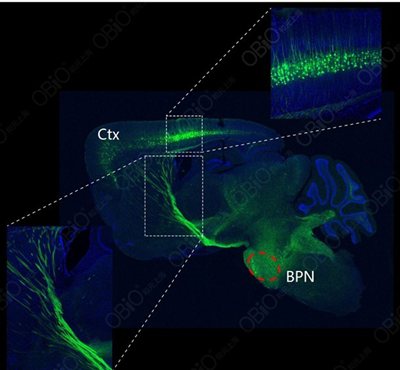
Injection site: Mouse BPN
Injection method: stereotactic injection into the brain
Vector: rAAV2-retro-hSyn-EYFP
Observation period: 4 weeks
2. AAV-PHP.eB: Whole-brain expression in the nervous system (crosses the blood–brain barrier)
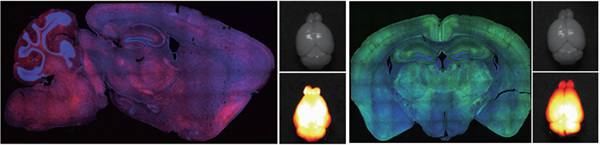
Injection route: Tail vein injection
Vector: pAAV-CMV-mScarlet-3FLAG & pAAV-CMV-mNeonGreen-3FLAG
Serotype: AAV-PHP.eB
Viral titer: 1.10×10¹³ VG/mL & 2.35×10¹³ VG/mL
Injection volume: 200 nl (total viral dose: 1.5 × 10¹¹ VG)
Observation period: 3 weeks
3. AAV-PAN: Specifically infects the pancreas

4. AAV-LUNG: Specifically infects the lungs
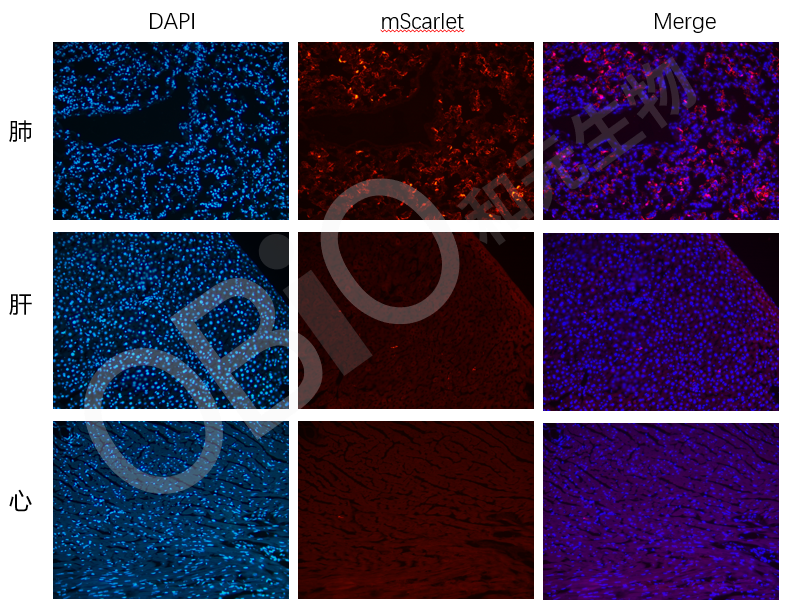
Injection method: Tail vein injection Vector: pAAV-CMV-mScarlet-3FLAG
Serotype: AAV-LUNG
Injection dose: 2 × 10¹¹ VG per animal (titer: 1.49 × 10¹³ VG/mL),
Injection volume: 200 µL
Observation period: 3 weeks
5. In vitro infection of 293T cells with AAV-DJ
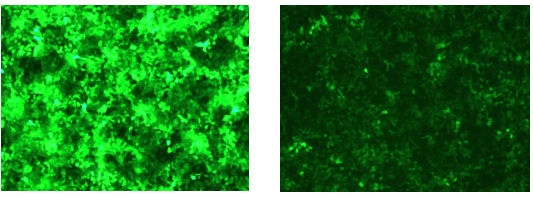
AAV-DJ (MOI=10^5) AAV8 (MOI=10^5)
 Telephone consultation


