


 返回

Original article link: HeYuan Bio – Stable Cell Line Construction
The expression of heterologous genes in cells can be categorized into two main types: transient expression, in which the foreign DNA or RNA does not integrate into the host chromosome and, although it can achieve high levels of expression, typically lasts only a few days; and stable expression (generation of stably transfected cell lines), in which the foreign DNA integrates into the host cell’s chromosome, enabling long-term expression of the target gene.
The establishment of stable cell lines is based on the principle of cloning exogenous DNA into a vector carrying a specific resistance marker. The vector is then transfected into host cells, where it integrates into the host genome, and cells are selected using the resistance marker encoded in the vector. The most commonly used resistance markers in eukaryotic expression vectors include neomycin, hygromycin, and puromycin. Through this selection process, cell lines can be obtained that stably express the target protein or stably silence a specific gene.
-
Screening method
Stable cell line selection via lentiviral infection
By leveraging the integrative expression properties of lentiviruses to screen for stable cell lines, this approach overcomes the time‑consuming limitations of conventional plasmid‑based single‑clone selection and enables the rapid, efficient generation of stable cell lines.
Advantages of generating stable cell lines using lentiviral vectors
(1) The cell line is broadly applicable and can be used with various mammalian cell types.
(2) The constructed stable transfectant exhibits a short establishment period and long-lasting expression.
(3) A variety of fluorescent labels and resistance genes are available, meeting the requirements of observational experiments.
-
Classification of Stable Cell Lines
Mixed-clonal stable cell line
Mixed clonal cell lines are obtained by directly selecting for drug resistance following gene transfection. The selected cells all express both the resistance gene and the gene of interest, but they comprise a variety of distinct cell clones. The integration sites and expression levels of the gene of interest differ among these clones.
Mixed clonal cell line screening is relatively rapid and cost-effective. When the target cell line to be constructed exhibits high transfection efficiency and robust expression of the gene of interest, the final expression levels achieved with a mixed clonal population are not significantly different from those obtained with a single‑clone population; in such cases, polyclonal cell line selection is the preferred approach.
Monoclonal stable cell line
A monoclonal cell line is a cell population derived from the expansion of a single cell that harbors a stably integrated exogenous DNA fragment. In such lines, the expression levels of the target gene at each integration site are highly uniform, though some phenotypic heterogeneity may be lost. Monoclonal cell line selection is time‑consuming and costly. Cell lines requiring subcellular localization studies, as well as those that are difficult to transfect or exhibit low expression levels, are typically recommended for monoclonal screening.
-
Service Process
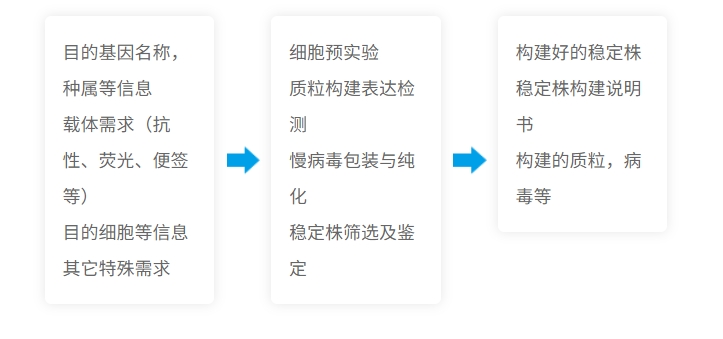
List of Constructed Stable Cell Lines (Partial)
|
Chinese name |
Corresponding stable strain |
Corresponding culture conditions |
Cell source |
|
Human brain astrocytic glioblastoma |
U-87 MG-luc-mNeonGreen-Puro |
MEM+10%FBS+2ug/ml Puromycin |
Chinese Academy of Sciences |
|
Human glioma cells |
U251-CMV-EGFP-Puro |
DMEM+10%FBS+2ug/ml Puromycin |
Chinese Academy of Sciences |
|
Human bladder transitional cell carcinoma cells |
T24-EGFP-Puro |
RPMI-1640+10%FBS+2ug/ml Puromycin |
Chinese Academy of Sciences |
|
Human pancreatic cancer cell line |
SW 1990-EGFP-Puro |
L-15+10%FBS+2ug/ml Puromycin |
Chinese Academy of Sciences |
|
Human neuroblastoma cells |
SK-N-SH-EGFP-Puro |
MEM+10%FBS+0.4ug/ml Puromycin |
Chinese Academy of Sciences |
|
Human breast cancer cells |
SK-BR-3-EGFP-Puro |
DMEM+10%FBS+2ug/ml Puromycin |
Chinese Academy of Sciences |
|
Human cervical squamous carcinoma cells |
SiHa-CMV-EGFP-Puro |
DMEM+10%FBS+2ug/ml Puromycin |
Chinese Academy of Sciences |
|
Mouse brain neuroblastoma cells |
Neuro-2a-EGFP-Puro |
MEM+10%FBS+2ug/ml Puromycin |
Chinese Academy of Sciences |
|
Mouse brain neuroblastoma cells |
Neuro-2a-CMV-Puro |
MEM+10%FBS+2ug/ml Puromycin |
Chinese Academy of Sciences |
|
Human breast cancer cells |
MDA-MB-468-EGFP-Puro |
L-15+10%FBS+2ug/ml Puromycin |
Chinese Academy of Sciences |
|
Human breast cancer cells |
MDA-MB-231-CMV-EGFP-Luc-Puro |
L-15+10%FBS+2ug/ml Puromycin |
Chinese Academy of Sciences |
|
Human breast cancer cells |
MCF7-CMV-EGFP-Puro |
MEM+10%FBS+2ug/ml Puromycin |
Chinese Academy of Sciences |
|
Mouse lung cancer cells |
LLC-CMV-sfGFP-Luc-Puro |
DMEM+10%FBS+2ug/ml Puromycin |
Chinese Academy of Sciences |
|
Human chronic myelogenous leukemia cells |
K-562-CMV-EGFP-Puro |
RPMI-1640+10%FBS+2ug/ml Puromycin |
Chinese Academy of Sciences |
|
Human T-lymphocyte leukemia cells |
Jurkat-CMV-EGFP-Puro |
RPMI-1640+10%FBS+0.5ug/ml Puromycin |
Chinese Academy of Sciences |
|
Human endometrial cancer cells |
ishikawa-CMV-Puro |
RPMI-1640+10%FBS+2ug/ml Puromycin |
Chinese Academy of Sciences |
|
Human hepatocellular carcinoma cells |
HuH-7-CMV-sfGFP-Luc-Puro |
DMEM+10%FBS+2ug/ml Puromycin |
Chinese Academy of Sciences |
|
Human hepatocellular carcinoma cells |
HuH-7-Luc Puro |
DMEM+10%FBS+2ug/ml Puromycin |
Chinese Academy of Sciences |
|
Human colon cancer cells |
HT-29-EGFP-Puro |
McCoy’s 5A+10%FBS+2ug/ml Puromycin |
Chinese Academy of Sciences |
|
Human hepatocellular carcinoma cells |
Hep G2-CMV-EGFP-Luc-Puro |
DMEM+10% FBS+2ug/ml Puromycin |
Chinese Academy of Sciences |
|
Human hepatocellular carcinoma cells |
Hep G2-CMV-Puro |
DMEM+10% FBS+2ug/ml Puromycin |
Chinese Academy of Sciences |
|
Human cervical cancer cells |
HeLa-EGFP-Puro |
DMEM+10% FBS+2ug/ml Puromycin |
Chinese Academy of Sciences |
|
Human cervical cancer cells |
HeLa-RFP-Puro |
DMEM+10% FBS+2ug/ml Puromycin |
Chinese Academy of Sciences |
|
Human colon cancer cells |
HCT 116-CMV-EGFP-Luc-Puro |
McCoy’s 5A+10%FBS+2ug/ml Puromycin |
Chinese Academy of Sciences |
|
Human pharyngeal squamous cell carcinoma cells |
FaDu-CMV-EGFP-Puro |
MEM+10%FBS+1ug/ml Puromycin |
Chinese Academy of Sciences |
|
Mouse colon cancer cells |
CT26.WT-CMV-Luc-Puro |
RPMI-1640+10%FBS+8ug/ml Puromycin |
Chinese Academy of Sciences |
|
Mouse colon cancer cells |
CT26.WT-CMV-Puro |
RPMI-1640+10%FBS+8ug/ml Puromycin |
Chinese Academy of Sciences |
|
Human renal clear cell carcinoma skin metastasis cells |
Caki-1-EGFP-Puro |
DMEM+10% FBS+2ug/ml Puromycin |
Chinese Academy of Sciences |
|
Hamster renal fibroblasts |
BHK-21 [C-13]-CMV-Puro |
MEM+10%FBS+2ug/ml Puromycin |
Chinese Academy of Sciences |
|
Human papillary thyroid carcinoma cells |
B-CPAP-CMV-EGFP-Puro |
RPMI-1640+10%FBS+1%NEAA+2ug/ml Puromycin |
Chinese Academy of Sciences |
|
Mouse melanoma cells |
B16-CMV-Puro |
RPMI-1640+10%FBS+1ug/ml Puromycin |
Chinese Academy of Sciences |
|
Mouse melanoma cells |
B16-CMV-EGFP-Puro |
RPMI-1640+10%FBS+1ug/ml Puromycin |
Chinese Academy of Sciences |
|
Human non-small cell lung cancer cells |
A549-CMV-EGFP-Puro |
F12K+10% FBS+2ug/ml Puromycin |
Chinese Academy of Sciences |
|
Human non-small cell lung cancer cells |
A549-luc-mNeonGreen-Puro |
F12K+10% FBS+2ug/ml Puromycin |
Chinese Academy of Sciences |
|
Mouse breast cancer cells |
4T1-CMV-Luc-Puro |
RPMI-1640+10%FBS+1ug/ml Puromycin |
Chinese Academy of Sciences |
|
Mouse breast cancer cells |
4T1-CMV-EGFP-Puro |
RPMI-1640+10%FBS+1ug/ml Puromycin |
Chinese Academy of Sciences |
|
Human gastric cancer cells |
MKN-45-CBh-luc2-mNeonGreenA-Puro |
RPMI-1640+20%FBS+2ug/ml Puromycin |
Xiehe |
|
Human lung adenocarcinoma cells |
NCI-H1975-CBh-luc2-mNeonGreenA-Puro |
RPMI-1640+10%FBS+2ug/ml Puromycin |
Chinese Academy of Sciences |
|
Human colon cancer cells |
HCT116-CBh-luc2-mNeonGreenA-Puro |
McCoy’s 5A+10%FBS+2ug/ml Puromycin |
Chinese Academy of Sciences |
 Telephone consultation


