


 返回

Original article link: HeYuan Bio – Non-coding RNA
Non-coding RNA refers to RNAs that do not encode proteins, including miRNA, lncRNA, circRNA, piRNA, and others. Non-coding RNAs exert their functions through diverse mechanisms, interacting with proteins, DNA, and other RNAs, and participating in a wide array of cellular processes. These include, but are not limited to, gene activation and silencing, RNA splicing, modification, and editing, as well as protein translation.
1. miRNA: miRNAs are a class of endogenous, non-coding single-stranded RNA molecules approximately 22 nucleotides in length, which participate in post-transcriptional regulation of gene expression in both animals and plants. Each miRNA can target multiple genes, while several miRNAs may regulate the same gene.
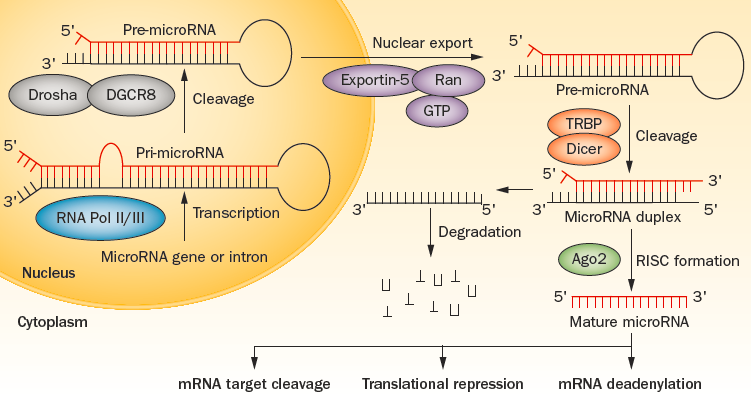
Figure 1: Mature miRNA and its mechanism of action (Mikhailidis DP, Athyros VG. Nat Rev Cardiol. 2014 Feb;11(2):72-4.)
miRNA overexpression: The miRNA precursor sequence is cloned into a viral vector, which can be used for transient transfection of cells or packaged into a virus for generating stable cell lines and for in vivo miRNA overexpression.
miRNA knockdown: Design TuD RNA–based decoy or sponge oligonucleotides targeting the miRNA, and then clone these sequences into a viral vector. This vector can be used for transient transfection of cells to achieve miRNA knockdown, or it can be packaged into lentivirus for in vivo miRNA knockdown in animal models.
miRNA target gene prediction: miRNAs recognize the 3′UTR of their target genes through base‑complementary pairing, and, depending on the degree of complementarity, recruit the silencing complex to either degrade the target mRNA or repress its translation. Accordingly, the 3′UTR of a gene of interest can be cloned into a luciferase‑based reporter construct; by comparing fluorescence signals in the presence of miRNA overexpression or an inhibitor versus the reporter alone, one can assess the regulatory effect of the miRNA on the target gene. Furthermore, site‑directed mutagenesis of the 3′UTR can be employed to pinpoint the specific binding sites between the miRNA and the target gene’s 3′UTR.
Common miRNA databases:
(1) miRBase (http://www.mirbase.org): miRBase is an online miRNA database developed by researchers at the University of Manchester. It provides a comprehensive resource that includes published miRNA sequence data, annotations, predicted gene targets, and more, making it one of the most prominent public databases for storing miRNA information.
(2) TargetScan (http://www.targetscan.org/): TargetScan predicts target genes by searching for conserved 8‑mer and 7‑mer sites that match the seed region of each miRNA.
(3) TarBase (http://carolina.imis.athena-innovation.gr/diana_tools/web/index.php?r=tarbasev8%2Findex): The TarBase database has been manually curated over approximately ten years to collect experimentally validated miRNA target genes, encompassing targets in humans, mice, fruit flies, nematodes, and zebrafish.
(4) miRWalk (http://www.ma.uni-heidelberg.de/apps/zmf/mirwalk/): miRWalk is a comprehensive database that provides predicted information on miRNAs from humans, mice, and rats, as well as experimentally validated binding sites on their target genes.
2. lncRNA: lncRNA is short for long non-coding RNA, a class of RNA molecules ranging in length from 200 to 100,000 nucleotides. Most lncRNAs exhibit distinct spatiotemporal expression patterns during tissue differentiation and development; they display low sequence conservation, with only about 12% being detectable in organisms other than humans.
Based on the genomic location of lncRNAs relative to protein-coding genes, they can be classified into seven types: promoter-associated, intronic, bidirectional, sense, antisense, 3′‑UTR‑associated, and intergenic. This positional context is highly informative for inferring the functions of lncRNAs.
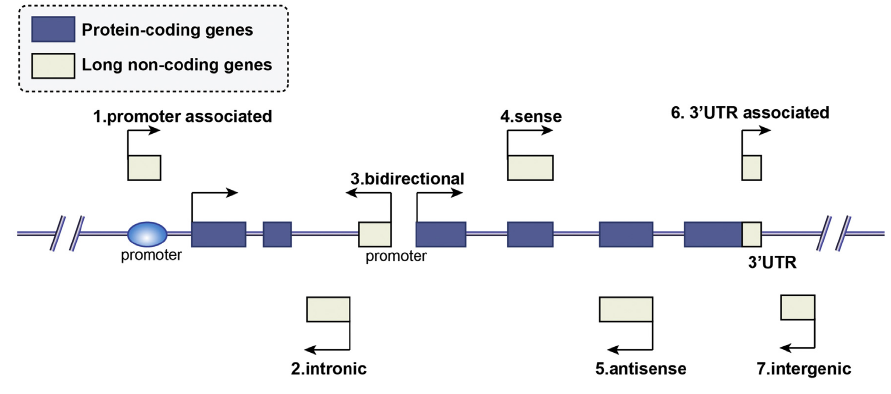
Figure 2: Classification of lncRNAs (Huang X, et al. Cancer Lett. 2018 Jan 28;413:94-101.)
In general, lncRNAs regulate gene expression primarily at the following three levels:
(1) Epigenetic regulation: lncRNAs recruit chromatin-remodeling complexes to specific genomic loci, thereby mediating the silencing of associated gene expression.
(2) Transcriptional regulation: This includes the following mechanisms: 1) lncRNA transcription can interfere with the expression of neighboring genes; 2) lncRNAs can disrupt gene expression by sequestering promoter regions; 3) lncRNAs can interact with RNA-binding proteins and recruit them to gene promoter regions, thereby modulating gene expression; 4) lncRNAs can regulate the activity of transcription factors; 5) lncRNAs can also control gene expression by modulating core transcription factors.
(3) Post-transcriptional regulation: lncRNAs can regulate gene expression at the post-transcriptional level by forming double-stranded complexes with mRNAs.
LncRNA overexpression: The lncRNA sequence is cloned into a viral vector, which can be used for transient transfection of cells or packaged into a virus for generating stable cell lines and achieving lncRNA overexpression in animal models.
lncRNA knockdown: Design a sequence-specific siRNA or shRNA targeting the lncRNA, and then clone this sequence into a viral vector. This vector can be used for transient transfection of cells to achieve lncRNA knockdown, or it can be packaged into a lentivirus for in vivo lncRNA knockdown in animal models.
lncRNA knockout: lncRNAs are knocked out using CRISPR/Cas9 technology. Multiple sgRNA sequences are designed to target both ends of a specific lncRNA fragment, enabling the deletion of a large genomic segment and achieving gene knockout. The sgRNA sequences are cloned into one viral vector, while the Cas9 sequence is packaged into a separate vector; the two vectors are then co‑infected into the target cells to mediate the knockout.
Identification of lncRNA target genes: The approach is essentially similar to the miRNA dual-luciferase assay described above.
3. circRNA: circRNA, short for circular RNA, is a class of non-coding RNA molecules that lack a 5′ cap and a 3′ poly(A) tail, forming a covalently closed loop structure, and are naturally present in living organisms.
Main characteristics of circRNAs:
(1) circRNAs are generated through a specialized form of alternative splicing and are abundantly present in the cytoplasm of eukaryotic cells, primarily originating from exons; a small fraction of circRNAs derived from introns is localized in the nucleus.
(2) The level of expression exhibits species-, tissue-, and time-specificity.
(3) circRNAs adopt a closed circular structure, making them resistant to degradation by exonucleases and more stable than linear RNAs.
(4) It exhibits a certain degree of sequence conservation.
(5) Exerts regulatory effects at the transcriptional or post-transcriptional level.
(6) The vast majority of circRNAs are non-coding, but a small subset can be translated into peptides.
circRNAs can be classified into three categories based on their origins: exonic circRNAs, circular intronic RNAs (ciRNAs), and retained-intron circRNAs, which are composed of both exons and introns.
Mechanisms of circRNA function:
miRNA molecular sponges—circRNAs contain numerous miRNA-binding sites, thereby functioning as miRNA sponges and indirectly regulating the expression of miRNA‑targeted downstream genes.
In addition to regulating gene transcription, circRNAs can also modulate protein function by interacting with RNA-binding proteins; for example, they can inhibit gene transcription by binding to transcription factors.
Coding function: Although circRNAs are classified as non-coding RNAs, a small subset can encode peptides that exert regulatory functions.
circRNA overexpression: Similar to the lncRNA protocol described above, circRNA overexpression is more challenging than conventional gene overexpression due to its lower circularization efficiency.
circRNA knockdown: Follows the same steps as the lncRNA method described above.
circRNA knockout: Follow the same steps as described above for lncRNA.
Identification of circRNA target genes: The dual-luciferase assay method used for miRNAs and lncRNAs as described above.
Our Advantages:
1) Extensive project experience and a high success rate;
2) Competitive pricing with discounts;
3) Short experimental duration;
4) Comprehensive after-sales service.
Services we can provide:
|
Service Content |
Service Type One |
Service Type Two |
|
miRNA overexpression |
Plasmid construction |
Lentivirus/Adeno-associated virus/Adenovirus |
|
miRNA interference |
Plasmid construction |
Lentivirus/Adeno-associated virus/Adenovirus |
|
lncRNA overexpression |
Plasmid construction |
Lentivirus/Adeno-associated virus/Adenovirus |
|
lncRNA interference |
Plasmid construction |
Lentivirus/Adeno-associated virus/Adenovirus |
|
lncRNA knockout |
Plasmid construction |
Lentivirus/Adeno-associated virus/Adenovirus |
|
circRNA overexpression |
Plasmid construction |
Lentivirus/Adeno-associated virus/Adenovirus |
|
circRNA interference |
Plasmid construction |
Lentivirus/Adeno-associated virus/Adenovirus |
|
circRNA knockout |
Plasmid construction |
Lentivirus/Adeno-associated virus/Adenovirus |
|
Dual-luciferase assay |
Plasmid construction |
Complete outsourcing services |
 Telephone consultation


