


 返回

HeYuan Bio’s research service platform offers cutting-edge, comprehensive, and rigorously designed vector design and construction services for researchers studying gene function, covering a wide range of vectors including standard eukaryotic expression vectors and viral vectors.
Viral vector construction services encompass lentiviral, adeno‑associated viral, adenoviral, and retroviral vectors. Our offerings include the design and construction of gene overexpression vectors, site‑specific mutant expression vectors, shRNA constructs for gene silencing, microRNA expression and inhibitory vector designs, luciferase reporter vector construction (covering UTRs, promoters, and other functional sequences), as well as the design and generation of Cre‑LoxP system and CRISPR/Cas9‑based genome‑editing vectors. We strive to provide a one‑stop solution for both gene upregulation and downregulation in functional genomics studies.
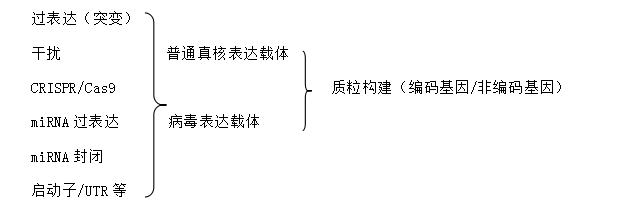
Plasmid advantages:
① Expression occurs rapidly; target gene expression can be observed approximately 24 hours after cell transfection.
② The construction is simple and cost-effective.
③ The library of overexpression vectors is extensive, and the selection markers for overexpression are diverse.
Fluorescent labels: GFP, mCherry, CFP, BFP, EYFP, mNeonGreen, tdTomato, mScarlet…
Tag labels: FLAG, HA, Myc, His tag…
Selection markers: Puro, Neo, Hygro, BSD…
Limitations:
① Transfection reagents are cytotoxic and can adversely affect cell viability after use.
② Most cells are difficult to transfect, making it impossible to achieve the desired genetic manipulation.
③ Plasmids do not integrate into the host cell genome and can only mediate short-term transient expression, making them unsuitable for experiments with extended observation periods.
Due to the inherent limitations of plasmids, it is necessary to package them into viral vectors to meet the diverse requirements of experimental studies.
Differences among various expression vectors
|
Expression system |
Eukaryotic expression vector |
Lentiviral vector |
Recombinant adeno-associated virus vector |
Recombinant adenoviral vector |
|
Carrier gene characteristics |
Double-stranded DNA plasmid |
RNA retrovirus |
Single-stranded DNA virus |
Double-stranded DNA virus |
|
Duration of exogenous gene expression |
Expression begins at 24 hours and persists for 3–7 days. |
Expression begins at 2–4 days and remains stable over a prolonged period. |
Expression begins at 7–14 days. |
Begins to express within 1–2 days. |
|
Insert fragment size |
Around 8 KB |
Around 4 KB |
About 2.8 KB |
About 6 KB |
|
Stable Cell Line Screening |
Difficult to operate |
Can do. |
No. |
No, it’s an instantaneous expression. |
|
Cellular experiment |
Cell lines with partially low transfection efficiency. |
First, broad-spectrum and highly efficient at infection. |
Not suitable |
Broad-spectrum, high infection efficiency |
|
Animal experimentation |
Not suitable |
Suitable, depending on the observation time and injection site. |
First, based on the observation time and injection site. |
High immunogenicity—use with caution. |
|
Titer range |
None |
108~109 TU/ml |
1012-1013vg/ml |
1010-1011pfu/ml |
Original article link: HeYuan Bio – Plasmid Construction
 Telephone consultation


