


 返回

Original article link: HeYuan Bio – Gene Overexpression
In studies of gene function, it is often necessary to upregulate the expression of the target gene to observe phenotypic changes. Overexpression refers to the process of achieving high-level expression of a target gene in a host cell; its underlying principle involves cloning the target gene into a vector and introducing it into the cell, thereby enabling robust transcription and translation and resulting in overexpression of the gene product. Commonly used vectors include prokaryotic expression vectors, standard eukaryotic expression vectors, lentiviral vectors, adeno-associated viral vectors, adenoviral vectors, and retroviral vectors.
Introduction to the Tool Carrier
Depending on experimental requirements and the size of the target gene, different vectors can be selected; both eukaryotic expression vectors and viral vectors are capable of achieving overexpression of both coding and non-coding genes.
| Expression system |
Eukaryotic expression vector |
Lentiviral vector |
Recombinant adeno-associated virus vector |
Recombinant adenoviral vector |
|
Carrier gene characteristics |
Double-stranded DNA plasmid |
RNA retrovirus |
Single-stranded DNA virus |
Double-stranded DNA virus |
|
Duration of exogenous gene expression |
Expression begins at 24 hours and persists for 3–7 days. |
Expression begins at 2–4 days and remains stable over a prolonged period. |
Expression begins at 7–14 days. |
Begins to express within 1–2 days. |
|
Insert fragment size |
Around 8 KB |
Around 4 KB |
About 2.8 KB |
Around 4 KB |
|
Stable Cell Line Screening |
Difficult to operate |
Can do. |
No. |
No, it’s an instantaneous expression. |
|
Cellular experiment |
Cell lines with partially low transfection efficiency. |
First, broad-spectrum and highly efficient at infection. |
Cell lines with low transfection efficiency for certain serotypes. |
Broad-spectrum, high infection efficiency |
|
Animal experimentation |
Not suitable |
Suitable, depending on the observation time and injection site. |
First, based on the observation time and injection site. |
High immunogenicity—use with caution. |
|
Titer range |
None |
108~109 TU/ml |
1012-1013VG/ml |
1010-1011PFU/ml |
Introduction to Common Elements in Vector Maps
| Component Name | Type | Purpose |
|
Promoter |
CMV, CAG, EF1a, U6, etc. |
Broad-spectrum or specific activation of the expression of target genes |
|
hSyn, CaMKIIα, etc. |
A tissue-specific promoter that initiates the expression of a target gene in specific tissues or cell types. |
|
|
Protein tag |
3xFLAG, HA, 6xHis, Myc, etc. |
It is fused with the target gene for expression and is commonly used to assess the expression levels of heterologous proteins. |
|
Fluorescent labeling |
EGFP, mCherry, mNeonGreen, etc. |
It can be expressed either as a fusion protein with the target gene or as a non‑fusion protein, enabling the assessment of transfection and infection efficiency. |
|
Resistance gene |
Puro, Neo, Hygro, BSD, etc. |
Eukaryotic resistance, commonly used for screening stable cell lines. |
|
Amp, Kan |
Prokaryotic resistance, commonly used in prokaryotic bacterial culture and plasmid amplification. |
|
|
Connecting component |
Left |
It is used to link two genes and is commonly employed in fusion expression, helping to mitigate the adverse effects of fusion expression on protein folding and function. |
|
IRES, 2A |
Used to link two genes, achieving non‑fusion expression. |
|
|
Other components |
WPRE |
Increase the expression of the target gene |
Carrier Selection (Partial)
The choice of viral vector should be guided by experimental requirements, with options including lentivirus, adeno-associated virus, adenovirus, and retrovirus.
| Carrier Category | Number | load Body component |
|
Lentiviral overexpression |
GL127 |
pSLenti-CMV-EGFP-3xFLAG-WPRE |
|
GL121 |
pSLenti-EF1-EGFP-CMV-MCS-WPRE |
|
|
GL107 |
pSLenti-EF1-EGFP-P2A-Puro-CMV-MCS-3xFLAG-WPRE |
|
|
GL122 |
pSLenti-EF1-EGFP-F2A-BSR-CMV-MCS-WPRE |
|
|
GL124 |
pSLenti-EF1-Luc2-F2A-Puro-CMV-MCS-WPRE |
|
|
Adenovirus overexpression |
H225 |
pADV-mCMV-MCS-3xFLAG |
|
H201 |
pADV-mCMV-EGFP-3xFLAG |
|
|
H213 |
pADV-mCMV-3xFLAG-EGFP |
|
|
H204 |
pADV-mCMV-mCherry-HA |
|
|
Adeno-associated virus overexpression |
AOV024 |
pAAV-CMV-EGFP-P2A-3xFLAG-WPRE |
|
AOV025 |
pAAV-CMV-mCherry-P2A-3xFLAG-WPRE |
|
|
AOV064 |
pAAV-hSyn-EGFP-P2A-3xFLAG-WPRE |
|
|
AOV065 |
AAV-hSyn-mCherry-P2A-3xFLAG-WPRE |
|
|
H9429 |
pAAV-CAG-EGFP-3xFLAG-tWPA |
|
|
H9525 |
pAAV-CMV-EGFP-3xFLAG-tWPA |
|
|
H10881 |
pAAV-CAG-EGFP-3xFLAG-tWPA |
|
|
H10886 |
pAAV-CMV-EGFP-3xFLAG-tWPA |
Service Overview
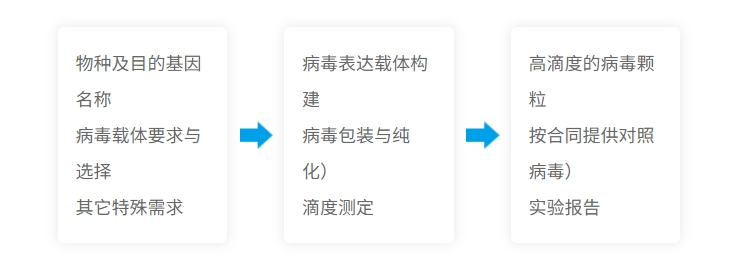
Based on the gene information provided by the customer, the cDNA sequence of the gene is retrieved from bioinformatics databases, and the cDNA is cloned into a vector. Depending on experimental requirements, the vector can be used to overexpress either coding or non-coding genes. For viral vectors, the packaged viral particles can be directly employed for cell infection or animal experiments.
Viral Vector Service Workflow
 Telephone consultation


