


 返回

Original article link: HeYuan Bio – Luciferase Reporter Gene Assay
Luciferase is an ideal reporter gene because mammalian cells lack endogenous luciferase, and once transcription is complete, a functional luciferase enzyme is immediately produced. Single‑reporter assays are often susceptible to various experimental variables, whereas dual‑reporter assays use a co‑transfected “control” as an internal reference to establish a baseline, thereby minimizing the influence of external factors such as cell viability and transfection efficiency and enhancing the reliability of the results. The Dual‑Luciferase® Reporter Assay System simultaneously expresses firefly luciferase and sea pansy luciferase in cells; these two enzymes share no sequence homology and each utilizes a distinct substrate, eliminating cross‑interference. Moreover, the system delivers exceptionally strong luminescent signals with an extremely high signal‑to‑noise ratio.
miRNA target gene validation
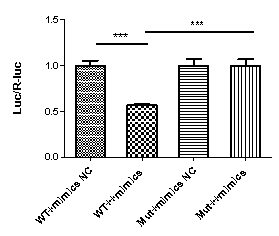
miRNAs primarily exert their effects by binding to the 3′UTRs of target genes, leading to mRNA degradation or translational repression. To identify the specific binding sites between a miRNA and its target gene’s 3′UTR, the 3′UTR sequences—both wild-type and mutant at the binding site—are cloned downstream of the firefly luciferase (F‑Luc) reporter gene in a vector. By comparing changes in reporter gene expression (i.e., whether luciferase activity decreases or remains unchanged) following miRNA overexpression, the functional interaction between the miRNA and the target gene’s 3′UTR can be determined.
Objective: To verify whether miRNAs exert regulatory effects on the 3’UTRs of their target genes.
Materials: plasmid pMIR-REPORT Luciferase gene 3'UTR (Wt); pMIR-REPORT Luciferase–gene 3'UTR (Mut); pRL-CMV (H321, Promega); 293T cell line
Steps: target prediction — plasmid construction — cell transfection and assay — reporter gene assay (luciferase activity measurement) — statistical analysis
Results Display:
Promoter Activity Assay
Transcription factors are protein molecules with a distinctive structure that regulate gene expression; they are also referred to as trans-acting factors. Some transcription factors bind exclusively to specific sequences within their target promoters; these specific sequences are known as cis‑elements. The DNA‑binding domain of the transcription factor forms covalent interactions with the cis‑element, thereby exerting either repressive or activating effects on gene expression.
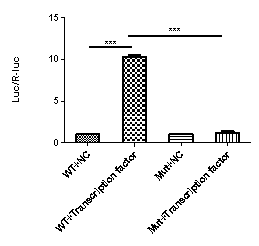
Transcription factors primarily exert their effects by binding to the promoters of target genes. By replacing the promoter sequence of a reporter gene, F‑Luc, with that of the gene of interest, and then co‑expressing the transcription factor, changes in reporter gene expression can be used to identify the transcription factor’s binding site on the target gene promoter and to determine its regulatory role on the target gene.
Objective: To assess the effect of transcription factors on the promoter activity of the target gene.
Materials: Experimental plasmid (pGL4.10–gene promoter); control plasmid; pRL-CMV (E2261, Promega); transcription factor plasmids; 293T cell line.
Steps: target prediction — plasmid construction — cell transfection and assay — reporter gene assay (luciferase activity measurement) — statistical analysis
Results Display:
Customer information required:
1 Target gene name
2 Target gene species
3 Name of the regulatory factor (miRNA or transcription factor)
Provided to the customer:
1 Binding Site Prediction Results
2 Plasmids and Their Construction Report
3 Dual-Luciferase Assay Report
 Telephone consultation


