


 返回
返回
返回

IF=26.8 | A New Breakthrough! The team of Xingdong Zhang and Xiangfeng Li at Sichuan University publishes in AM: Achieving Effective Osteoporotic Bone Regeneration
I. Literature Review
Recently, an interdisciplinary research team led by Academician Xingdong Zhang and Professor Xiangfeng Li from the National Biomedical Materials Engineering Technology Research Center at Sichuan University published an academic paper titled “Brake–Drive Osteo System: Sequential Modulation of the Inflammatory Microenvironment and Osteogenesis for Osteoporotic Bone Defect Regeneration” in Advanced Materials (latest impact factor: 26.8).
The team has developed a novel biomaterial system, the “Brake–Drive Osteo System,” which effectively achieves functional regeneration of osteoporotic bone defects.
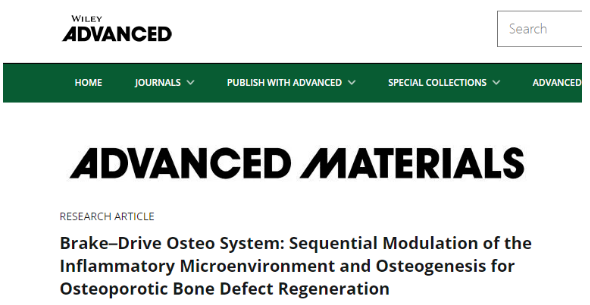
(Image captured from the literature)
Xiao Zhuojie, a doctoral student at the West China School of Clinical Medicine/West China Hospital of Sichuan University, is the first author of this paper.
Professor Xiangfeng Li of the National Biomedical Materials Engineering Technology Research Center at Sichuan University is the corresponding author of the paper.
II. Literature Summary

Cited from Li Ji Bio ® Product:
AC03L156- Fetal Bovine Serum (FBS)
Bone defects resulting from osteoporosis are characterized by chronic inflammation and diminished bone‑forming capacity, posing significant challenges to skeletal regeneration. Conventional scaffold materials fail to effectively modulate the inflammatory microenvironment or to balance anti‑inflammatory and pro‑osteogenic signaling, thereby hindering the simultaneous resolution of inflammation and new bone formation.
The research team designed a “braking–driving” bone regeneration system: a biomaterial that combines quercetin‑loaded nanovesicles with nucleic acid structures carrying teriparatide, both integrated into a calcium phosphate scaffold to form the BCP‑T/N@Q/V composite. This design enables a sequential therapeutic process: first, quercetin suppresses inflammatory responses, thereby reducing resistance to bone formation; subsequently, teriparatide promotes osteogenesis. This mechanism helps reprogram macrophages into phenotypes that favor bone regeneration while mitigating inflammation, thus establishing an immune microenvironment conducive to bone repair. Such immunomodulatory effects markedly enhance the osteogenic capacity and maturation of bone marrow mesenchymal stem cells in patients with osteoporosis. In a murine model of osteoporotic femoral condyle defects, this scaffold accelerated bone regeneration and yielded newly formed bone with improved structural integrity, demonstrating its potential for clinical application.
Overall, this “braking–driving” bone regeneration system, by integrating anti-inflammatory resolution with bone formation, offers an effective approach to skeletal regeneration in osteoporosis.
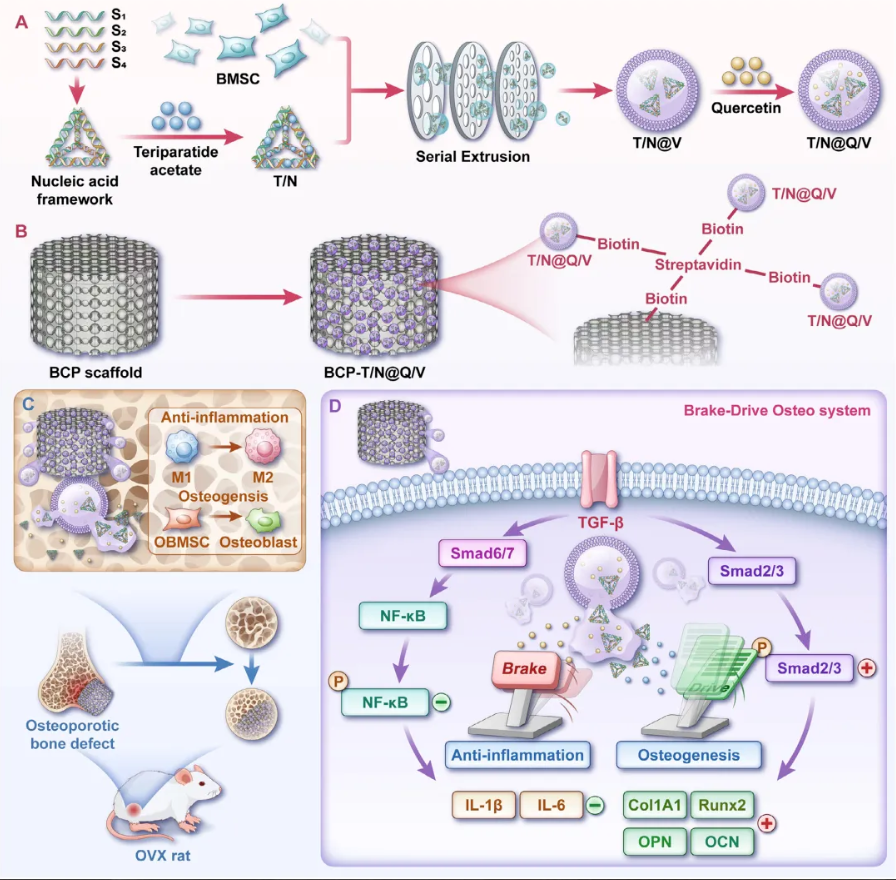
Image excerpted from the literature: Schematic diagram of the “braking–driving bone system.”
Article link: https://doi.org/10.1002/adma.72909
Group Website
-
Contact Information
Landline phone:021-50778506
Business Manager:18616108315Business Cooperation/Scholarships:18616108697
Address:4th Floor, Building 27, Lane 908, Ziping Road, International Medical Park, Pudong New Area, Shanghai
Email:ztt0005@obiosh.com

WeChat Official Account
Online Customer Service 1
Online Customer Service 2
 Telephone consultation


