


 返回
返回
返回

IF=15.6 | Huazhong Agricultural University publishes a paper: Zebrafish reveal new insights into human blood disorders and identify potential novel therapeutic targets.
I. Literature Review
Recently, a team led by Professor Jingxia Liu from the College of Fisheries at Huazhong Agricultural University, together with Associate Professor Yaping Fang and Professor Guoliang Li from the College of Information Science, jointly published an academic paper in Advanced Science titled “Nap1L4a Cooperates with Scl/Klf1 to Recruit H2A.Z in Mediating Interactions Among Cis-Regulatory Elements and Transcription Required for Primitive Erythropoiesis in Zebrafish” (latest impact factor: 15.6).
The system has shed light on the mechanisms underlying primitive erythropoiesis in vertebrates and has also provided a new theoretical perspective and potential therapeutic targets for understanding the pathogenesis of human hematological disorders such as congenital anemia and thalassemia.
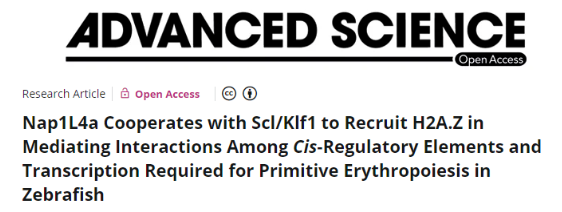
(Image captured from the literature)
Shi Jiahao, a doctoral student at the College of Fisheries; Lai Fuming, a graduated master’s student from the College of Information; and Shen Zheng, a graduated master’s student from the College of Fisheries, are the first authors of this paper.
Professor Jingxia Liu of the College of Fisheries and Associate Professor Yaping Fang of the School of Information at Huazhong Agricultural University are the co-corresponding authors of the paper.
Professor Li Guoliang of the School of Information and Professor Li Kuanyu of the School of Medicine at Nanjing University provided crucial guidance, while graduate students Zhang Xiaoyan and Wang Hanfei, as well as alumnus Dr. Wang Yunlong and postdoctoral fellow Liu Wenye, also contributed to this research.
II. Literature Summary

Cited from Li Ji Bio ® Product:
AC15L141-Collagenase, Type Type II collagenase
The chromatin-remodeling protein nucleosome assembly protein 1-like 4 (Nap1L4) is highly expressed in megakaryocyte–erythroid progenitors and erythroid cells. In diseases such as acute myeloid leukemia, mutations, deletions, or aberrant expression of Nap1L4 have been observed. However, the molecular mechanisms by which Nap1l4a contributes to erythropoiesis and related pathologies remain unclear.
Studies have shown that zebrafish nap1l4a homozygous mutants (nap1l4a−/−) are more sensitive to hypoxic stress during early embryonic development, and their primitive erythropoiesis is impaired. Mechanistically, Nap1l4a in zebrafish interacts with the erythroid transcription factors Scl and Klf1 and also recruits the histone variant H2A.Z. This interaction alters the architecture of cis‑regulatory elements, thereby promoting the transcription of erythroid genes. Furthermore, the absence of Nap1l4a reduces the accessibility of epigenetic regulators such as kdm6b and kmt2c, leading to increased H3K27me3 and decreased H3K4me1 marks in erythrocytes. Consequently, the histone modification landscape at erythroid transcription factor gene loci is altered, resulting in reduced expression levels of these transcription factors. In addition, Nap1l4a modulates the WNT/β‑catenin signaling pathway through both transcriptional and epigenetic mechanisms, thereby influencing the process of primitive erythropoiesis.
In summary, these findings demonstrate that, during primitive erythropoiesis in vertebrates, Nap1l4a exerts lineage‑specific transcriptional regulation that depends on histone‑based epigenetic modifications. These results provide new insights into the mechanisms underlying human hematological disorders and hypoxic responses associated with Nap1l4a deficiency.
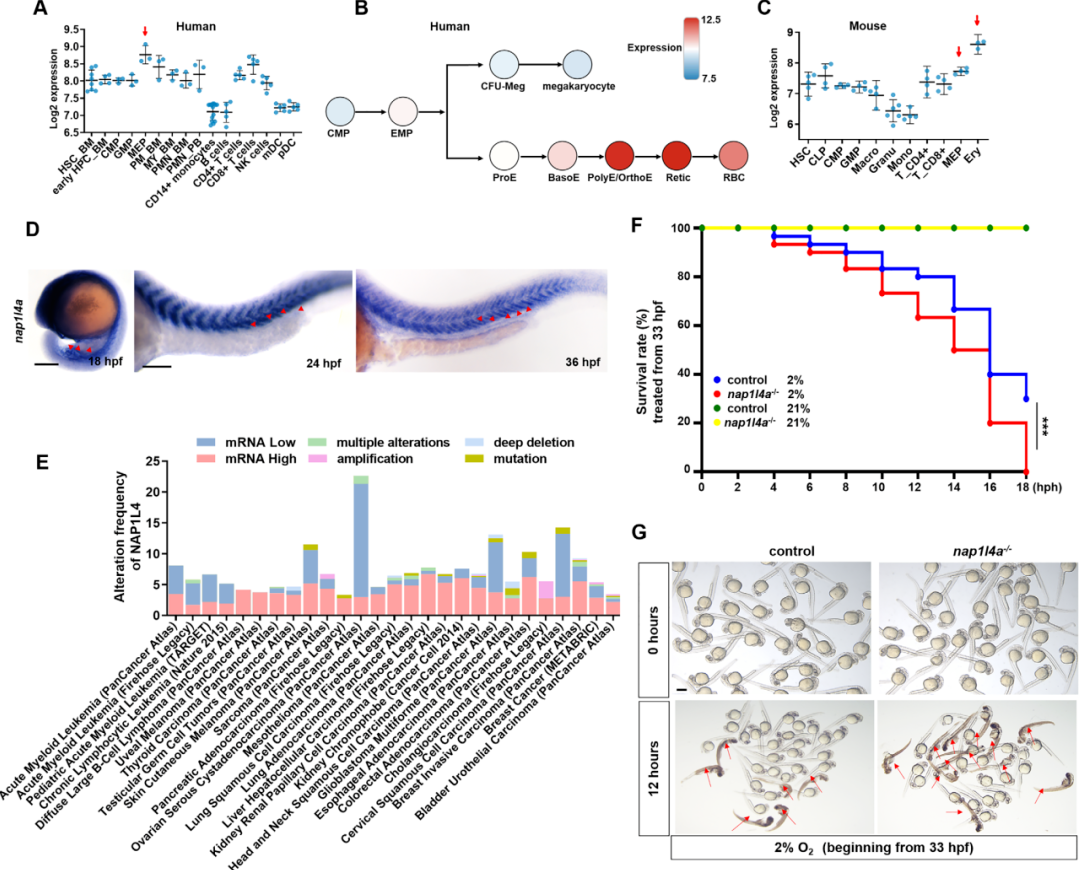
Image captured from the literature.
Article link: https://doi.org/10.1002/advs.202513762
Group Website
-
Contact Information
Landline phone:021-50778506
Business Manager:18616108315Business Cooperation/Scholarships:18616108697
Address:4th Floor, Building 27, Lane 908, Ziping Road, International Medical Park, Pudong New Area, Shanghai
Email:ztt0005@obiosh.com

WeChat Official Account
Online Customer Service 1
Online Customer Service 2
 Telephone consultation


