


 返回
返回
返回

Principles and Methods of Cell Cryopreservation (Selection of Cryopreservation Solutions)
In recent years, therapeutic approaches involving the infusion of immune cells or stem cells have yielded promising outcomes in treating various diseases, highlighting the increasingly broad clinical potential of cell‑based therapies. Typically, a considerable time elapses between cell collection and clinical application, and fresh cell products have limited shelf lives. To extend the storage duration of cells or to preserve them long term, cryopreservation is required.
The principle of cryopreservation of cells
Cell cryopreservation is a technique that involves exposing cells to low-temperature conditions using cryoprotective agents to reduce cellular metabolism and maintain cell viability, enabling long-term storage. Upon thawing, the proteins remain active, and the cells’ structure and function remain intact.
As the temperature decreases, water both inside and outside the cells crystallizes, and the resulting ice crystals can damage cell membranes and organelles. Particularly in the range of 0 to −20°C, the ice crystals are needle‑shaped and readily induce cellular injury. When cells are cryopreserved directly without any cryoprotectants, the ice crystals that form in the intracellular and extracellular environments can cause mechanical damage, elevated electrolyte concentrations, altered osmotic pressure, dehydration, changes in pH, and protein denaturation, ultimately leading to cell death.
When cryoprotectants are added to a cell suspension, they protect cells from both solute‑induced damage and ice‑crystal–mediated injury. Cryoprotectants readily bind to water molecules, lowering the freezing point; under slow freezing conditions, they facilitate the efflux of intracellular water before ice crystals form, while also reducing the concentration of electrolytes in the extracellular solution, thereby mitigating solute‑induced damage. As a result, cells can be preserved at ultra‑low temperatures (e.g., liquid nitrogen). The effectiveness of cryoprotectants in safeguarding cells further depends on the freezing rate, the freezing temperature, and the thawing rate, and different cryoprotectants exhibit varying degrees of protective efficacy.
Cell cryoprotectant
Cryoprotectants can be classified into two types—permeable and non-permeable—based on their ability to cross the cell membrane. Permeable cryoprotectants can diffuse through the cell membrane into the cell; they are typically small molecules, including dimethyl sulfoxide (DMSO), glycerol, ethylene glycol, propylene glycol, methanol, and ethanol. These agents penetrate the cell before the cryopreservation suspension fully freezes, thereby reducing intracellular ice crystal formation and minimizing cellular damage. DMSO is a key component of clinical‑grade cryoprotective formulations; standard cryoprotectant solutions generally contain about 10% DMSO. As the most widely used cryoprotectant and a common pharmaceutical excipient, DMSO’s detailed specifications are available in the Pharmaceutical Excipient Database maintained by the Center for Drug Evaluation of the National Medical Products Administration. Non-permeable cryoprotectants are usually large‑molecular‑weight substances that cannot pass through the cell membrane. They include dextran, sucrose, polyethylene glycol, dextran, and albumin. These compounds preferentially bind to water molecules in the solution, lowering the freezing point and inhibiting ice crystal formation. Due to their high molecular weight, they also reduce the concentration of electrolytes in the solution, thereby mitigating solute‑induced damage, while simultaneously decreasing the levels of low‑molecular‑weight solutes (electrolytes) and alleviating salt‑induced injury.
General Procedure for Cryopreservation of Cells
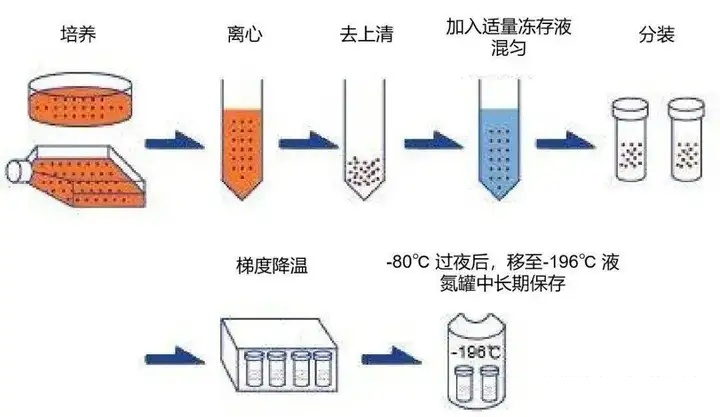
The cryopreservation process should be carried out slowly, whereas the thawing step requires rapid warming. As explained above, slow freezing is employed to prevent intracellular water from forming ice crystals before it has time to exit the cells, which could otherwise cause cellular damage. (1) Prior to cryopreservation, assess cell viability and perform a cell count. (2) Collect the cells to be cryopreserved in a centrifuge tube, centrifuge at 1,200–1,800 × g for 5 minutes, and discard the supernatant. (3) Adjust the cell density according to requirements, then slowly add an appropriate volume of pre‑cooled cryopreservation medium or commercially available serum‑free cryopreservation solution to resuspend the cells. (4) Aliquot the cell suspension into cryovials, tightly seal the caps, and label them accordingly. (5) Place the cryovials in a programmed cooling box (pre‑cooled), transfer them to a −80°C freezer overnight, and on the following day move them to a liquid nitrogen tank for long‑term storage.
How to Choose a Cell Cryopreservation Solution
The quality and composition of cryopreservation media significantly influence the success of cell cryopreservation. If the media’s formulation is inappropriate or its quality fails to meet standards, it may result in cryopreservation failure or reduced post-thaw viability.
When selecting a cell cryopreservation solution, the following three key factors should be considered:
(1) Cell type: Different cell types have varying requirements for the composition and concentration of cryopreservation solutions.
(2) Cryopreservation duration: The longer cells are cryopreserved, the more stringent the requirements for the cryopreservation solution.
(3) Recovery rate: The quality and composition of the cell cryopreservation solution significantly affect the cell recovery rate.
Now let me introduce to you... Li Ji Bio ~The main products of Li Ji Biological Cell Cryopreservation Solution are:
Pharmaceutical‑grade cell cryopreservation solution (non‑programmed freezing)
Rapid Cell Cryopreservation Solution (GMP Grade)
Serum-free cell cryopreservation solution (DMSO-free)
Serum-Free Cell Cryopreservation Solution (Enhanced)
Rapid Cell Cryopreservation Solution (Serum-Free, Protein-Free)
1. Rapid Cell Cryopreservation Solution (Serum-Free, Protein-Free)
Product Description
Heyuan Lizhi Rapid Cell Cryopreservation Solution (serum‑free, protein‑free) is compatible with the vast majority of tumor cells and conventional cell lines, as well as most stem cell types (please refer to our official website for a list of cell types tested by Heyuan Lizhi). Cryopreserved cells can be stored long-term at −80°C for more than six years. Free of animal‑derived proteins and serum components, this solution effectively minimizes contamination by bacteria, viruses, mycoplasma, and other microorganisms, ensuring the safety of cryopreserved cells. Formulated with DMSO, glucose, and other essential cell nutrients, it enhances cell survival and viability, making it suitable for serum‑free culture systems and for cells used in protein expression studies.
Product Advantages
1. No stepwise cooling is required; cells can be directly placed in cryopreservation solution and stored at −80°C (where they can remain viable for more than 6 years). The cryopreservation solution does not need to be diluted.
2. The cryopreservation solution is serum-free, significantly reducing the risk of cellular contamination.
3. Do not add serum, do not perform repeated stepwise cooling, and do not use liquid nitrogen; overall, this approach saves both time and money.
Case studies are available for review on the official website under “Resources & Support”! For cell cryopreservation data, please refer to the Li Ji Cryopreservation Solution Database below (data sourced from user feedback).
Product ingredients
Product Name | Item number | Specifications |
Rapid Cell Cryopreservation Solution (Serum-Free, Protein-Free) | AC05L032 | 30mL |
Rapid Cell Cryopreservation Solution (Serum-Free, Protein-Free) | AC05L033 | 100mL |
Transportation and Storage
Store at room temperature. Keep refrigerated at 4°C; shelf life: 24 months.
II. Serum-Free Cell Cryopreservation Solution (DMSO-Free)
Product Description
Li Ji Biological Serum-Free Cell Cryopreservation Solution (DMSO-free) is suitable for the cryopreservation of a wide range of cell types, particularly primary hepatocytes, neuronal cells, and others.
Order Information
Product Name | Item number | Specifications |
Serum-free cell cryopreservation solution (DMSO-free) | AC05L164 | 100mL |
Product Specifications
pH value: | 7.2–7.8 at 25±2℃ |
Bacteria: | Negative |
Fungi: | Negative |
Mycoplasma: | Negative |
Transportation and Storage
Blue ice transport. Store sealed at 4°C; shelf life: 12 months.
III. Serum-Free Cell Cryopreservation Solution (Enhanced)
Product Description
Li Ji Biological Serum-Free Cryopreservation Solution (Enhanced) is suitable for the cryopreservation of commonly used animal cell lines and is particularly well suited for the freezing of primary cells, stem cells, and other cell types.
Order Information
Product Name | Item number | Specifications |
Serum-Free Cell Cryopreservation Solution (Enhanced) | AC05L053 | 100mL |
Product Specifications
Appearance: | Pale yellow clear solution |
pH value: | 7.2–7.8 at 25±2℃ |
Bacteria: | Negative |
Fungi: | Negative |
Mycoplasma: | Negative |
Endotoxin: | <1 EU/mL |
Transportation and Storage
Blue ice transport. Store sealed at 4°C; shelf life: 24 months.
IV. Rapid Cell Cryopreservation Solution (GMP Grade)
Product Description
HeYuan Li Ji Rapid Cell Cryopreservation Solution (GMP‑grade) is free of animal‑derived proteins and serum components, effectively minimizing contamination by bacteria, viruses, mycoplasma, and other microorganisms to ensure the safety of cryopreserved cells. It is suitable for a wide range of animal cell lines and is particularly well‑suited for the cryopreservation of primary cells, stem cells, hybridoma cells, and other protein‑expressing cell types.
This product contains a proprietary blend of protectants and stabilizers that significantly lowers the freezing point of the cryopreservation solution, enhances cell membrane permeability to water, and effectively prevents ice crystal–induced cellular damage. It also reduces the extracellular electrolyte concentration during freezing, thereby mitigating osmotic stress, and slows the mechanical compression of cells during cryopreservation, further safeguarding the cell membrane. As a result, it markedly improves cell recovery rates and viability.
Product Advantages
Convenience : Ready-to-use; no programmed cooling is required. Cells can be directly placed in cryopreservation solution and stored at −80°C, or subsequently transferred to liquid nitrogen for long-term preservation.
Efficient Cell viability and post-thaw recovery are high, generally exceeding 90%.
Safety : Serum-free, free of animal-derived components, with a well-defined chemical composition, significantly reducing the risk of cellular contamination.
High quality : Rigorous quality control ensures product performance comparable to imported counterparts; all raw materials are sourced from rigorously tested, low-endotoxin, high-purity pharmaceutical-grade supplies, formulated with a low‑DMSO content, and prepared using water for injection in full compliance with GMP manufacturing standards.
Small batch-to-batch variation : The entire production and packaging process is carried out in a GMP‑compliant cleanroom, and the product undergoes rigorous quality testing for endotoxins, osmotic pressure, pH, bacterial pathogens, and other parameters, ensuring consistent product quality and batch-to-batch uniformity.
Wide range of applications : Suitable for a wide range of animal cell lines, particularly well‑suited for cryopreservation of primary cells, stem cells, and hybridoma‑derived protein‑expressing cells; experimental evidence has demonstrated that it does not alter stem cell phenotype or growth status and can maintain their multipotency.
Product ingredients
Product Name | Item number | Specifications |
Rapid Cell Cryopreservation Solution (GMP Grade) | AC05L043 | 100mL |
Transportation and Storage
Blue ice transport. Store at 4°C; shelf life: 12 months.
V. Pharmaceutical‑Grade Cell Cryopreservation Solution (Non‑Programmed Cooling)
Product Description
Pharmaceutical‑grade cell cryopreservation solution (non‑programmed freezing) is an off‑the‑shelf, serum‑free, animal‑component‑free formulation independently developed by Li Ji Biotechnology. It contains 7.5% DMSO and provides a safe, effective protective environment for cells under ultra‑low temperatures (-80°C to -196°C), achieving cell viability rates exceeding 90% after thawing and recovery.
This product contains an aqueous solution of glycine, DMSO, and a phosphate-buffered saline, and is suitable for the cryopreservation of mesenchymal stem cells.
Order Information
Product Name | Item number | Specifications |
Pharmaceutical‑grade cell cryopreservation solution (non‑programmed freezing) | AC05L174 | 100mL |
Product Specifications
Appearance: | Clear, transparent solution |
Net content: | Shall not be less than the labeled quantity. |
pH value: | 7.0–7.6 (25±2°C) |
Osmotic pressure: | 1650–2025 mOsmol/kg |
Sterile: | Should exhibit sterile growth. |
Mycoplasma: | Shall comply with the regulations. |
Endotoxin: | <0.25 EU/mL |
Transportation and Storage
Blue ice transport. Store sealed at 4°C; shelf life: 24 months.
This product is intended solely for scientific research and must not be used for clinical diagnosis, treatment, or any other purposes.
Group Website
-
Contact Information
Landline phone:021-50778506
Business Manager:18616108315Business Cooperation/Scholarships:18616108697
Address:4th Floor, Building 27, Lane 908, Ziping Road, International Medical Park, Pudong New Area, Shanghai
Email:ztt0005@obiosh.com

WeChat Official Account
Online Customer Service 1
Online Customer Service 2
 Telephone consultation


