


 返回
返回
返回

Li Ji Bio Pre-stained Protein Molecular Weight Standards (Classification and Selection of Protein Markers)
Protein markers, also known as protein molecular weight standards, are mixtures of proteins with known molecular weights that serve as a “ruler” to help determine the size of protein bands. In Western blotting, protein markers are primarily used to estimate the molecular weights of protein bands; they can also assist in assessing the success of protein transfer or monitoring the electrophoretic progress of proteins on the gel. Therefore, selecting an appropriate protein marker is one of the key factors for experimental success.
Li Ji Bio Pre-stained protein molecular weight standards
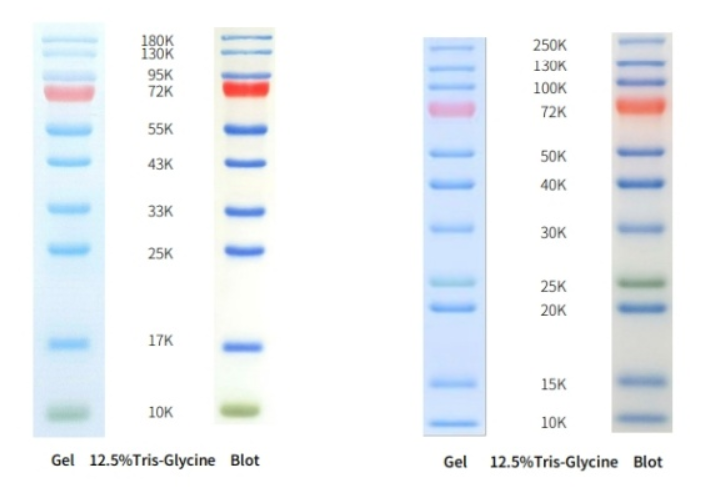
Pre-stained proteins exhibit different apparent molecular weights under different buffer systems; the two figures above show electrophoresis profiles obtained with two distinct buffers. They are well suited as protein molecular weight standards for SDS‑PAGE and Western blotting, serving as reliable references for determining protein sizes in these assays.
Classification of Protein Markers
• Unstained Markers: Non‑stained protein markers are invisible during electrophoresis and only become visible after protein staining at the end of the run, thus providing no real-time indication during the experiment. However, because these markers do not carry any dye or labeling molecules, the molecular weights they display correspond precisely to the proteins’ native sizes, making them the most accurate option.
• Pre-stained markers: Contain dyes and proteins, visible to the naked eye, allowing direct observation of electrophoresis progress and confirmation of complete transfer. They are widely used; however, because the marker proteins are covalently conjugated with the dye, the migration efficiency of the protein molecules is altered, so the molecular weights indicated are not exact and may contain a certain degree of error.
• Exposure Marker: During the exposure step, both the target band and the marker band can be simultaneously exposed and visualized, reducing errors and compensating for changes in the migration rate of pre-stained markers; however, this method is costly.
Selection of Protein Markers
• Scope Coverage
When selecting protein markers, ensure that their molecular weight range covers the size of the target protein you are studying. In general, choose standards with small, medium, and large molecular weights to encompass proteins of varying sizes.
• Dual Marker
Some markers are dual-labeled and can be stained during electrophoresis; such markers are suitable for two-color labeling applications (e.g., fluorescence and chemiluminescence), offering greater experimental flexibility.
• Quality and stability
Select high-quality, stable protein markers from reputable suppliers to ensure consistent performance and accuracy.
Group Website
-
Contact Information
Landline phone:021-50778506
Business Manager:18616108315Business Cooperation/Scholarships:18616108697
Address:4th Floor, Building 27, Lane 908, Ziping Road, International Medical Park, Pudong New Area, Shanghai
Email:ztt0005@obiosh.com

WeChat Official Account
Online Customer Service 1
Online Customer Service 2
 Telephone consultation


