


 返回
返回
返回

Introduction to RIPA Lysis Buffer and How to Choose It
When it comes to protein extraction, RIPA lysis buffer is often the first thing that springs to mind: simply add the buffer to your sample and centrifuge to isolate the proteins. But are we really using RIPA lysis buffer correctly? RIPA lysis buffer is a widely employed solution for extracting proteins from animal cells or tissues. Its mechanism relies on detergents—surfactants—to disrupt cell and nuclear membranes, thereby releasing RIPA‑soluble proteins from the cellular and tissue matrix.
Selection of RIPA Lysis Buffer
RIPA lysis buffer primarily contains detergents, a buffering system, an isotonic agent, denaturants, stabilizers, and other components. Among these, detergents are key constituents of cell lysates; they are amphiphilic molecules composed of a hydrophobic tail and a polar, hydrophilic head group. Detergents reduce the surface tension of water and are therefore classified as surfactants, functioning to disrupt lipid bilayers, lyse cells, and solubilize proteins.
Types of detergents
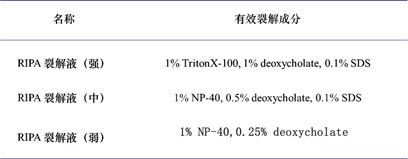
Different types of detergents exhibit varying efficiencies in lysing samples. RIPA lysis buffer comes in multiple formulations, typically employing combinations of different detergents at varying concentrations. Consequently, the amount and diversity of proteins solubilized by different RIPA formulations can differ substantially, yielding distinct protein profiles and leading to variability in downstream experimental outcomes. It is therefore essential to select an appropriate RIPA lysis buffer formulation based on the specific sample type and the requirements of the downstream assays.
Precautions for Using Ripa Lysis Buffer
• Because most RIPA lysis buffers exhibit relatively mild lysis conditions, they are particularly effective for extracting cytoplasmic soluble proteins as well as certain proteins that are highly expressed on the cell membrane or in the nucleus. Therefore, RIPA lysis buffer is well suited for isolating such proteins and is recommended for qualitative analysis in Western blotting experiments.
• When extracting proteins with RIPA lysis buffer, centrifugation yields two fractions: the RIPA‑soluble fraction (supernatant) and the RIPA‑insoluble fraction (white precipitate), which is normal. Avoid pipetting up the precipitate; instead, collect the supernatant for downstream applications.
• If the sample becomes noticeably viscous after adding RIPA lysis buffer, it indicates that lysis was overly complete and nucleic acid residues remain. In such cases, use a milder lysis buffer formulation, increase sonication, or switch to a different total protein extraction kit (Li Ji Bio, Cat: AP01L204). For column‑based purification, employ a spin column to retain residual nucleic acids, thereby addressing sample viscosity; with no insoluble contaminants present, you can obtain a more comprehensive protein profile.
• When extracting tissue samples using RIPA lysis buffer, the substantial variability among tissue types poses a challenge for efficiently isolating total protein. For instance, fibrous and collagenous tissues—such as the heart and kidneys—and soft tissues—such as the spleen and liver—require tailored grinding protocols to achieve optimal results.
Group Website
-
Contact Information
Landline phone:021-50778506
Business Manager:18616108315Business Cooperation/Scholarships:18616108697
Address:4th Floor, Building 27, Lane 908, Ziping Road, International Medical Park, Pudong New Area, Shanghai
Email:ztt0005@obiosh.com

WeChat Official Account
Online Customer Service 1
Online Customer Service 2
 Telephone consultation


