


 返回
返回
返回

Principle, experimental procedure, and precautions of the BCA method for protein quantification
Protein concentration determination is an essential method for calculating the recovery yield of purification procedures. Commonly used assays include the biuret method, the Lowry method, UV absorbance-based methods, and the BCA protein assay. Among these, the BCA method—also known as the bicinchoninic acid or bicinchoninate method—is the most widely employed. BCA stands for Bicinchoninic Acid Assay, sometimes referred to as the Smith Assay, and was developed by Paul K. Smith. This technique assesses protein concentration by measuring the color change observed in samples of varying concentrations.
Detection principle
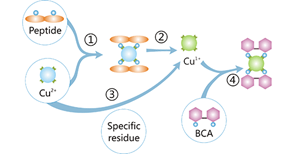
BCA is an alkaline, water-soluble complex with stable properties. Under the alkaline conditions it provides, proteins reduce Cu²⁺ in the BCA reagent to Cu⁺, which then chelates with the BCA reagent to form a blue‑purple complex exhibiting a strong absorption peak at 562 nm. By measuring the absorbance and using a standard curve, the protein concentration can be determined. The BCA assay is widely used due to its strong resistance to interference, simplicity, accuracy, and high sensitivity; however, it is also susceptible to variations in temperature and incubation time.
Experimental Procedure
I. Preparation of Standard Solutions and Working Solutions
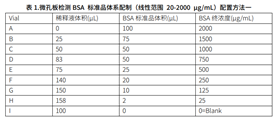
1. Prepare the BSA standard curve (linear range: 20–2000 μg/mL, or 5–250 μg/mL). Two preparation methods are provided for each concentration; select the appropriate method based on your preference. [Note]: The BSA standard solution has a concentration of 2 mg/mL, and the diluent is the same as that used to dissolve the protein samples. In principle, egg…
The blank sample should be diluted in the same solution as the standard; however, it may also be diluted with water or 1× PBS. BSA standard preparation table (prepared solutions can be stored at 4°C and reused multiple times).
2. Prepare the BCA working solution
① Calculate the total volume of BCA working solution required. Total BCA working solution volume = (number of standards + number of samples to be tested) × number of replicates × per well.
The BCA working solution required for the samples. [Note]: For tube-based assays, add 2.0 mL of BCA working solution to each sample; for microplate assays, each…
Add 200 μL of BCA working solution to the sample.
② Preparation of BCA working solution: Add 1 volume of BCA reagent B to 50 volumes of BCA reagent A (A:B = 50:1), and mix thoroughly. [Note]: The BCA working solution should be stored in a sealed container and remains stable at room temperature for 24 hours.
II. Testing Methods
1. Test tube assay method (sample: BCA working solution = 1:20)
2. Microplate assay method (sample: BCA working solution = 1:20)
① Add 10 μL of the standard solution and the sample to be tested into the microtiter plate. [Note]: The ratio of sample to working solution is 1:20, and the detection range is 125–2000 μg/mL. If the sample concentration is very low, you may use 25 μL of the standard solution and the sample to be tested (i.e., a 1:8 dilution); in this case, the kit’s detection…
The measurement range is 20–2000 μg/mL.
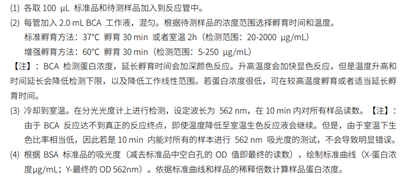
② Add 200 μL of BCA working solution to each well and gently pipette up and down to ensure thorough mixing. Cover the microplate and incubate at 37°C for 30 minutes.
③ Cool to room temperature, then measure the absorbance at 562 nm using a microplate reader.
④ Based on the absorbance values of the BSA standards (subtracting the OD value of the blank well in each standard to obtain the final reading), construct a standard curve (X-axis: protein concentration).
μg/mL; Y—final OD at 562 nm). The protein concentration of the sample was calculated based on the standard curve and the sample’s dilution factor.
Precautions
During the BCA assay for determining protein concentration, precision and reliability are of paramount importance. Below are some key procedural considerations, along with common issues that may arise during the experiment and corresponding troubleshooting strategies:
▶ Reagent preparation and storage: Ensure that all reagents are thoroughly mixed before use and stored at the recommended temperature. The freshness of reagents significantly affects experimental results; expired or improperly stored reagents may lead to inaccurate outcomes.
▶ Strict adherence to the experimental protocol: When performing the BCA assay, follow the reagent addition sequence and procedural steps precisely, avoiding any reversal or omission of steps. This sequential design is intended to maximize reaction efficiency and ensure consistent results.
Group Website
-
Contact Information
Landline phone:021-50778506
Business Manager:18616108315Business Cooperation/Scholarships:18616108697
Address:4th Floor, Building 27, Lane 908, Ziping Road, International Medical Park, Pudong New Area, Shanghai
Email:ztt0005@obiosh.com

WeChat Official Account
Online Customer Service 1
Online Customer Service 2
 Telephone consultation


