


 返回
返回
返回

What should you do if fungal contamination occurs in cell culture? (How can fungal contamination be prevented?)
Fungal contamination is also one of the most common types of contamination in cell culture. Typically, fungal contamination has a more pronounced effect on the surrounding local cells, while cells elsewhere continue to grow normally. Moreover, because fungi reproduce via spores, once contamination occurs, it can easily spread.
▶ Main Types of Fungal Contamination : Contamination by Aspergillus fumigatus, Aspergillus niger, Mucor species, Candida albicans, and yeasts (as shown in the figure) exhibits the following characteristics:
① Generally, the culture medium does not become turbid;
② It is relatively easy to observe: under the naked eye, punctate colonies (pale yellow or white) can be seen floating on the surface of the culture medium.
③ Under a conventional inverted microscope, flocculent, interwoven hyphae or fungal aggregates can be observed growing between the cells; occasionally, the fungi are not directly associated with the cell‑adhering layer, necessitating careful microscopic examination to locate the hyphae or fungal masses.
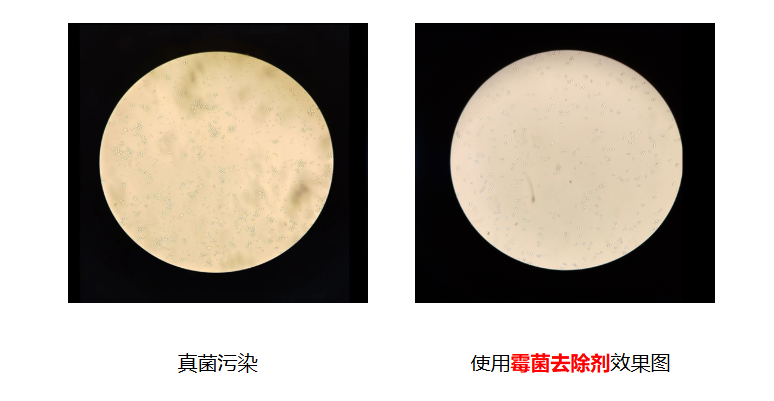
▶ How to Prevent Fungal Contamination
✔ Fungi propagate via spores. If mold colonies or white filamentous colonies are present in the incubator, carefully wipe them with paper moistened with 75% ethanol, then seal and dispose of the material to prevent spore dispersal and secondary contamination.
✔ After “fungi” contaminate the cells, be sure to pipette out the fungal clumps before proceeding with washing and treatment.
✔ Cells contaminated with “fungi” are handled during washing, medium changes, and other procedures by separately collecting and disinfecting both the waste liquid and solid waste to prevent cross-contamination.
▶ Recommended mold removal products
EZ Moulds Rid is a standard supplement for cell culture, primarily used to prevent mold contamination in both small-scale and large-scale cultures. By disrupting ion-exchange channels in the cell membrane and compromising membrane permeability, it effectively kills molds of various forms and exhibits strong inhibitory activity against common fungal contaminants in cell culture, such as Candida and yeasts.
[Brand] Li Ji Bio
[Name] EZ Mold Remover (Moulds Rid)
[Item Number] AC16L181
[Specification] 500 μL
Group Website
-
Contact Information
Landline phone:021-50778506
Business Manager:18616108315Business Cooperation/Scholarships:18616108697
Address:4th Floor, Building 27, Lane 908, Ziping Road, International Medical Park, Pudong New Area, Shanghai
Email:ztt0005@obiosh.com

WeChat Official Account
Online Customer Service 1
Online Customer Service 2
 Telephone consultation


