


 返回
返回
返回

IF=44.5 | High-impact publication in Nature Biotechnology: The team led by Chen Jia, Yang Li, and Hong Jiaxu collaboratively developed a virus-like particle delivery system for efficient in vivo cytosine base editing.
I. Literature Review
2026 On July 10, the team led by Chen Jia at ShanghaiTech University, in collaboration with the teams of Yang Li and Hong Jiaxu at Fudan University, jointly published an academic paper titled “Efficient in vivo cytosine base editing via virus-like particles with uracil DNA glycosylase inhibition” in Nature Biotechnology (latest impact factor: 44.5).
This study developed a virus-like particle (VLP) delivery system to achieve efficient cytosine base editing in vivo.
(Image captured from the literature)
Junjie Zhu, a 2022 Ph.D. student at the School of Life Science and Technology of ShanghaiTech University; Lin Ding, a 2024 Ph.D. student; Jifang Li, a 2025 Ph.D. graduate; Kaiming Liu, a 2024 graduate student at the Institute of Biomedical Sciences of Fudan University; and Xingyu Zhu, a 2023 master’s student at the Eye, Ear, Nose and Throat Hospital of Fudan University (who will enter the Ph.D. program in September 2026), are co‑first authors.
Professor Jia Chen of the Gene Editing Center, School of Life Science and Technology, ShanghaiTech University; Professor Li Yang of the Institute of Biomedical Sciences, Fudan University, and the Children’s Hospital of Fudan University; and Professor Jiaxu Hong of the ENT Hospital of Fudan University are the corresponding authors of this paper.
II. Literature Summary
Cited from Li Ji Bio ® Product:
AC04L092-EZ Trans Cell Transfection Reagent (High Efficiency)
By leveraging VLPs as delivery vehicles, editors can be transiently delivered into cells either as ribonucleoprotein complexes or as mRNA. Compared with AAV- or plasmid-based delivery, VLPs help mitigate off-target editing and potential safety risks associated with the long-term expression of the editor. Previously, VLPs have been used to deliver Cas9–sgRNA, adenine base editors (ABEs), and prime editors (PEs); however, VLP‑mediated cytosine base editing (CBE) has yet to achieve high in vivo efficiency. CBE achieves C-to-T conversion by deaminating cytosine to uracil, but endogenous uracil DNA glycosylases (UNGs) recognize and excise uracil from DNA, thereby reducing C-to-T editing efficiency and increasing unwanted byproducts. Conventional AAV- or plasmid‑based delivery can sustain UGI protein expression to suppress UNG activity, whereas VLP delivery provides only a single, limited dose of UGI protein.
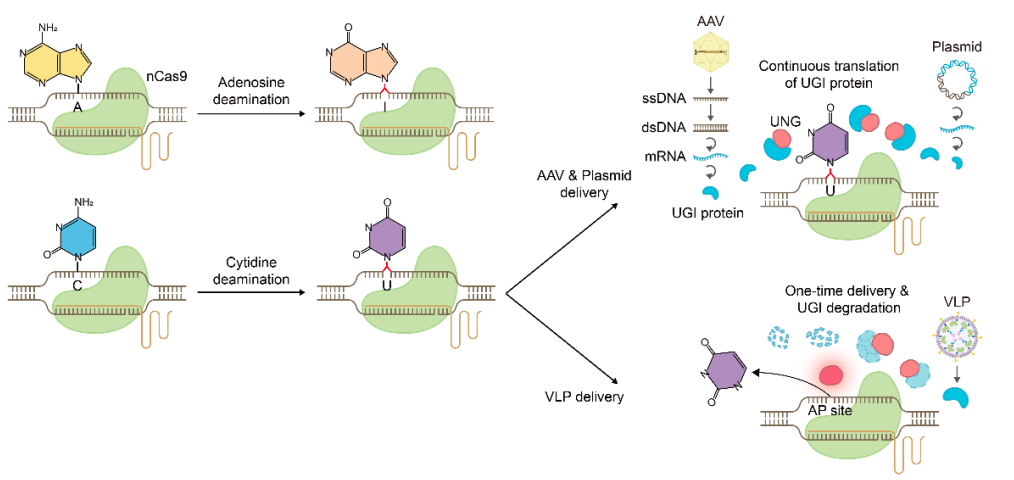
Image captured from the literature.
The research team found that insufficient UNG inhibition may limit the in vivo editing efficiency of VLP‑delivered CBEs (Figure 1a). Compared with wild-type cells, hUNG/hSMUG1 double-knockout cells exhibited a marked increase in C-to-T editing efficiency, accompanied by a substantial reduction in C-to-A and C-to-G off‑target products. These findings confirm that endogenous uracil DNA glycosylase activity is a key factor constraining VLP‑CBE editing efficiency. To address the central issue of low C-to-T editing efficiency caused by inadequate UNG inhibition, the team systematically optimized both the tBE system and the VLP packaging strategy. They introduced an additional RNA aptamer into tBE to enhance UGI recruitment and developed several improved VLP platforms. Among these, the optimized tBE‑VLP4 significantly boosted the loading levels of UGI and sgRNA within the VLP, demonstrating stable and efficient cytosine base editing across 293FT, HeLa, U2OS, and monkey‑derived FRhK‑4 cells. Further analyses revealed that tBE‑VLP4 is also compatible with the Cas9 SpG variant and conventional CBE architectures, underscoring the system’s broad applicability and scalability.
In mouse in vivo experiments, tBE‑VLP4 demonstrated robust editing efficiency and effective disease‑modifying outcomes (Figure 2). Following a single tail‑vein injection, tBE‑VLP4 achieved an average C-to-T editing rate of 46.0% at the mPcsk9 locus in the mouse liver, concomitantly reducing serum PCSK9 protein levels and total cholesterol. In a mouse model of hereditary tyrosinemia type I, the research team used tBE‑VLP4 to target the mHpd locus, attaining a peak editing efficiency of 64.2%. This treatment successfully rescued the mice from weight loss and mortality and markedly ameliorated hepatic functional impairment. Furthermore, the team delivered tBE‑VLP4 to retinal pigment epithelial cells via subretinal injection, targeting the mVegfa locus, with an average editing efficiency of 24.2%. In a laser‑induced choroidal neovascularization model, this approach significantly attenuated lesion severity and conferred neuroprotective effects on retinal function, suggesting that tBE‑VLP4 is not only suitable for hepatic editing but also holds promise for applications in ophthalmic therapeutics. Regarding safety, the research team observed no detectable off‑target DNA or RNA editing induced by tBE‑VLP4 in both in vitro and in vivo assays. Compared with AAV‑ or LNP‑mRNA‑based delivery systems, tBE‑VLP4 exhibited superior editing specificity.
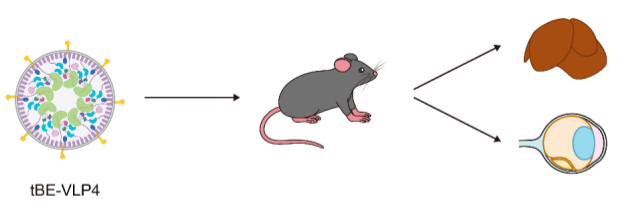
Image captured from the literature.
This study elucidated the key mechanisms underlying the limited in vivo efficiency of VLP‑mediated CBE delivery and, based on these findings, established a highly efficient and precise in vivo cytosine base‑editing platform, tBE‑VLP4, thereby offering a new technological approach for safe and effective in vivo gene‑editing therapies.
Article link: https://www.nature.com/articles/s41587-026-03227-9
Group Website
-
Contact Information
Landline phone:021-50778506
Business Manager:18616108315Business Cooperation/Scholarships:18616108697
Address:4th Floor, Building 27, Lane 908, Ziping Road, International Medical Park, Pudong New Area, Shanghai
Email:ztt0005@obiosh.com

WeChat Official Account
Online Customer Service 1
Online Customer Service 2
 Telephone consultation


