


 返回
返回
返回

IF=15 | Yuan Xianglin’s team has identified a new clinical targeted therapeutic approach for radiation-induced pulmonary fibrosis.
I. Literature Review
The research team led by Professor Yuan Xianglin from the Department of Oncology at Tongji Hospital, affiliated with Tongji Medical College of Huazhong University of Science and Technology, has published an academic paper titled “An inhalable nanozyme for STING blockade to treat radiation-induced lung injury” in the journal JOURNAL OF NANOBIOTECHNOLOGY (latest impact factor: 15).
The team elucidated the molecular mechanisms by which cell–cell interactions within the local microenvironment drive fibrosis progression and proposed a targeted intervention strategy that precisely inhibits the paracrine release of pro-inflammatory cytokines. By modulating macrophage function and suppressing the excessive activation of fibroblasts, this study achieved a significant reversal of the fibrotic phenotype in lung tissue, both in vitro and in vivo, offering a highly translational new approach for the clinical targeted treatment of radiation‑induced pulmonary fibrosis.
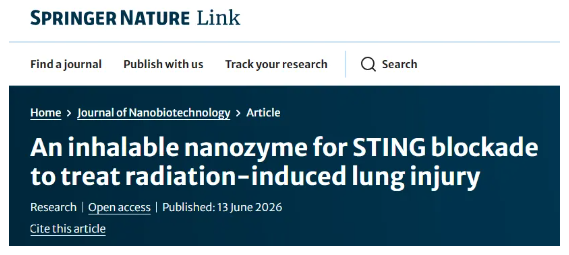
Image captured from the literature.
II. Literature Overview
Radiation‑induced lung injury (RILI), encompassing radiation pneumonitis (RP) and radiation‑induced pulmonary fibrosis (RIPF), is a common complication of thoracic radiotherapy that often limits the achievable treatment dose. Acute radiation pneumonitis can impede the continuation of radiotherapy, whereas radiation‑induced pulmonary fibrosis leads to irreversible impairment of lung function. Under ionizing radiation, the STING pathway becomes activated, triggering oxidative stress in macrophages; this not only gives rise to acute radiation pneumonitis but also lays the groundwork for subsequent pulmonary fibrosis.
In this study, researchers developed an inhalable iron-based nanozyme—FeRAzyme—that encapsulates rosmarinic acid to address radiation‑induced lung injury. Using molecular docking and molecular dynamics simulations, they selected rosmarinic acid as the active component of this nanozyme. Experimental results demonstrated that rosmarinic acid binds noncovalently to the STING protein’s Ser243–Tyr245–Leu259–Glu260–Asn211 sequence, thereby inhibiting STING phosphorylation. Following a screening of various metal‑based nanozymes, FeRAzyme exhibited robust catalase‑ and superoxide dismutase‑like activities, effectively scavenging reactive oxygen species and mitigating radiation‑induced oxidative damage. Upon inhalation, FeRAzyme suppresses STING phosphorylation, reduces oxidative stress in macrophages, and consequently attenuates the secretion of proinflammatory cytokines.
Both in vitro and in vivo studies demonstrate that FeRAzyme can effectively restore macrophage homeostasis, alleviate acute radiation‑induced pneumonitis, and suppress myofibroblast activation, all without eliciting systemic toxicity. This research offers a dual‑functional STING‑inhibiting nanoenzyme strategy for mitigating radiation‑induced lung injury, heralding new prospects for radioprotection in thoracic cancer radiotherapy.
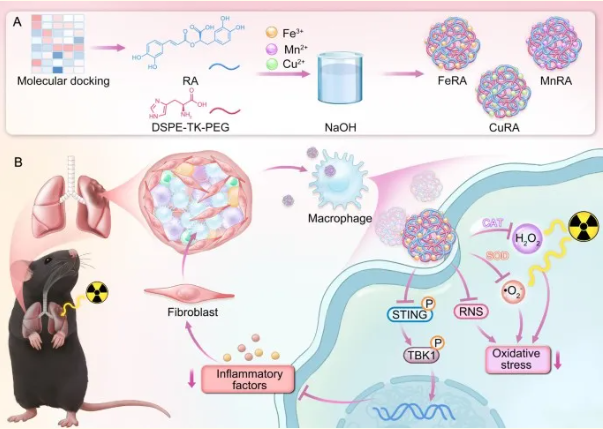
Image captured from the literature.
Article link: https://doi.org/10.1186/s12951-026-04636-3
III. Referenced Products
In this study on the use of nanoenzymes to treat radiation‑induced lung injury, three reagents from Li Ji Bio® were employed for cell viability assays, RNA extraction, and nuclear staining, serving as essential foundational tools in the experimental workflow.
1. CCK-8 Assay Kit (AC11L054)
Function: Used for cell viability assays.
Specific application: Researchers used the CCK‑8 assay kit to evaluate the effects of various concentrations of herbal extracts on the viability of bone marrow–derived macrophages (BMDMs). By measuring cellular metabolic activity, they could determine whether the compounds exert cytotoxicity and identify those with protective effects.
2. Total RNA extraction kit (Trizol) (AN51L758)
Function: Used for the extraction of total RNA.
Specific applications: This reagent is used to extract total RNA from two types of samples:
Mouse lung tissue (for subsequent RNA sequencing analysis).
Cells cultured in vitro (for subsequent real-time fluorescent quantitative PCR analysis).
Extracted RNA is a prerequisite for analyzing gene expression levels.
3. DAPI staining solution (AS21L122/AS21L123)
Function: A nuclear fluorescent dye.
Specific application: In immunofluorescence assays, DAPI is used to stain cell nuclei. The blue fluorescence it emits clearly marks the nuclear location, serving as a background reference that helps researchers localize and visualize the intracellular distribution of other target proteins, such as p‑STING and SFTPC.
Group Website
-
Contact Information
Landline phone:021-50778506
Business Manager:18616108315Business Cooperation/Scholarships:18616108697
Address:4th Floor, Building 27, Lane 908, Ziping Road, International Medical Park, Pudong New Area, Shanghai
Email:ztt0005@obiosh.com

WeChat Official Account
Online Customer Service 1
Online Customer Service 2
 Telephone consultation


