


 返回
返回
返回

IF=17.1 | A new breakthrough in cultivated meat: A team from Zhejiang University has created “snowflake pork.”
I. Literature Review
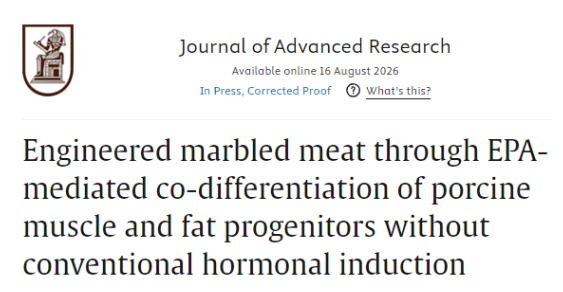
On August 16, 2026, Professor Zhong Dan’s team at Zhejiang University published the academic paper “Engineered marbled meat through EPA-mediated co-differentiation of porcine muscle and fat progenitors without conventional hormonal induction” in the Journal of Advanced Research (latest impact factor: 17.1).
The research team focused on n‑3 long-chain polyunsaturated fatty acid eicosapentaenoic acid (EPA). Previous studies have shown that EPA modulates lipid metabolism and promotes muscle protein synthesis while reducing muscle protein breakdown, suggesting it could serve as a novel inducer linking muscle formation with lipid deposition. Concurrently, the team engineered an edible CK hydrogel using food‑grade κ‑carrageenan and konjac glucomannan, providing a three‑dimensional growth environment for two cell types. Building on this platform, the study further explored an EPA‑mediated co‑differentiation strategy between muscle and adipose tissues, generating centimeter‑scale cultured meat with tunable fat content. The resulting “snowflake pork” was evaluated using food‑science metrics such as texture and nutritional composition, offering new technical insights for the coordinated construction of muscle and fat in structured cultured meat.
Gu Xin, a 2026 Ph.D. graduate from the College of Animal Sciences at Zhejiang University, is the first author of this paper.
Professor Dan Tizhong of the College of Animal Sciences at Zhejiang University is the corresponding author of this paper.
Citing Li Ji Bio® products:
1. AP13L062 – Three-Color Pre-Stained Protein Marker (10–250 kDa)
2. AN51L758 – Total RNA Extraction Kit (Trizol)
3. AC08L011-1X PBS (Sterile)
(Image captured from the literature)
II. Literature Overview
In conventional pork, the “marbling” formed by intramuscular fat not only affects visual quality but is also closely linked to tenderness, juiciness, and flavor. However, for cultivated meat, achieving coordinated growth of muscle and fat within a single system is challenging: the differentiation requirements of myocytes and adipocytes differ, and components such as dexamethasone commonly used in traditional adipogenesis induction systems may even inhibit muscle differentiation.
Recently, Professor Dan Ti Zhong’s team at Zhejiang University published a study in the Journal of Advanced Research, proposing a muscle–fat co‑differentiation strategy based on eicosapentaenoic acid (EPA). By integrating an edible hydrogel scaffold, they engineered a prototype of cultured “snowflake pork” that exhibits both muscular and adipose tissue characteristics.
The study first constructed a CK composite hydrogel using food-grade κ‑carrageenan and konjac glucomannan (KGM). This scaffold features an interconnected porous structure, providing cells with a three-dimensional growth environment. Specifically, a 1% CK hydrogel with a κ‑carrageenan to KGM mass ratio of 4:6 exhibits a Young’s modulus of approximately 13.6 kPa, which falls within the mechanical range of 8–17 kPa observed in the extracellular matrix of native skeletal muscle. Experimental results demonstrate that this scaffold can both support the proliferation of myoblasts and their differentiation into mature myotubes, as well as promote adipocyte differentiation and lipid accumulation, thereby laying the groundwork for simultaneously “growing muscle” and “growing fat.”
The real challenge lies in achieving the simultaneous differentiation of both lineages. Researchers co‑cultured porcine muscle satellite cells (pMuSCs) with porcine fibroblast–adipocyte progenitors (pFAPs). They found that, while a conventional adipogenic protocol containing IBMX, dexamethasone, and insulin promoted adipogenesis, it markedly suppressed myogenic differentiation, leading to reduced expression of muscle‑specific markers such as MyoG and MyHC. To resolve this contradiction, the team employed 100 μM eicosapentaenoic acid (EPA) to enhance lipid accumulation. In a two‑dimensional co‑culture system, compared with a control group induced solely by horse serum, EPA increased intracellular triglycerides (TG) and total cholesterol (TC) by approximately 4.06‑fold and 1.63‑fold, respectively. Concurrently, myotubes became longer and more compact, with MyHC and desmin expression upregulated by about 1.88‑fold and 1.42‑fold, respectively. Further validation in a three‑dimensional collagen‑based hydrogel system confirmed that EPA likewise boosted lipid accumulation while effectively preserving myogenic differentiation and myotube maturation.
Notably, EPA‑induced lipid accumulation was not accompanied by a significant upregulation of all canonical adipogenic marker genes. Accordingly, the authors hypothesize that this effect may stem not only from conventional adipocyte differentiation pathways but also from mechanisms involving fatty acid transport, utilization, and intracellular lipid metabolism regulation; the precise molecular underpinnings remain to be elucidated. Ultimately, the research team generated centimeter‑scale muscle–fat composite cultured meat. Texture analysis revealed that, compared with cell‑free hydrogels, cell‑based cultivation markedly enhanced the scaffold’s hardness, chewiness, and elasticity; moreover, several textural parameters of the EPA‑induced cultured meat approached those of commercially available pork belly used in the experiments. Nutritional profiling indicated that per 100 g wet weight, the EPA‑supplemented cultured meat contained approximately 4.56 g of protein and 8.10 g of fat, with total fat content about 125% higher than that of the horse serum–based control group.
However, this still falls significantly short of real pork. At present, cultivated meat contains lower absolute levels of both protein and fat than commercially available pork, and the pork belly used in the study for comparison consists primarily of muscle tissue and layered adipose tissue, which does not fully replicate the “marbling” formed by intramuscular fat in natural meat. The researchers also note that future work will need to increase cellular biomass and tissue maturation, further optimize the spatial distribution of fat, and systematically assess amino acid profiles, fatty acid compositions, bioavailability, and long-term stability. Overall, the key breakthrough of this study lies in constructing a three-dimensional culture environment using an edible CK hydrogel and employing EPA to promote lipid deposition while mitigating the adverse effects of conventional fat-induction systems on muscle formation. This approach offers a new technological pathway for developing next-generation structured cultured meats with tunable fat content, textures closer to those of real meat, and even customizable fatty acid profiles.
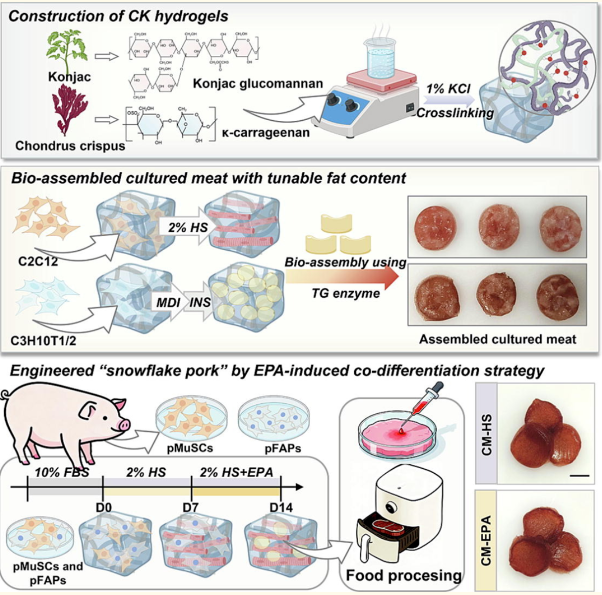
Image captured from the literature.
Article link: https://doi.org/10.1016/j.jare.2026.08.043
III. Referenced Products
In this study, three reagents from Li Ji Bio® collectively established a comprehensive chain of evidence supporting the paper’s central finding: “EPA‑mediated co‑differentiation,” spanning the three levels of “gene → protein → morphology.”
1. AP13L062 – Three-Color Pre-Stained Protein Marker (10–250 kDa)
Function: Molecular weight standard for Western blotting.
Specific applications: This marker is used in all Western blot experiments described in the paper as a molecular-weight standard for protein electrophoresis. The three-color pre-stained marker (10–250 kDa) spans a molecular-weight range of 10–250 kDa, enabling simultaneous detection of the target proteins mentioned above—such as MF20 (~200 kDa), desmin (~53 kDa), PLIN1 (~47 kDa), FASN (~280 kDa), and β‑tubulin (~50 kDa)—and facilitating real-time monitoring of separation efficiency during electrophoresis as well as confirmation of the target protein band positions after transfer to the membrane.
2. AN51L758 – Total RNA Extraction Kit (Trizol)
Function: Total RNA extraction for qRT-PCR experiments.
Specific applications: TRIzol is used to extract total RNA from various cultured samples, including C2C12 cells differentiated in different CK hydrogels, pMuSCs at proliferative and differentiative stages, and 2D/3D co-culture systems under different induction protocols.
3. AC08L011-1X PBS (Sterile)
Function: Washing buffer and base solution for reagent preparation in cell experiments.
Specific applications: PBS (phosphate-buffered saline) is used extensively in the paper, spanning multiple experimental steps: 1) lipid droplet staining; 2) immunofluorescence staining; and 3) routine cell culture experiments.
Sterility specifications ensure that bacterial or mycoplasma contamination does not compromise the results of cell culture and staining experiments.
Group Website
-
Contact Information
Landline phone:021-50778506
Business Manager:18616108315Business Cooperation/Scholarships:18616108697
Address:4th Floor, Building 27, Lane 908, Ziping Road, International Medical Park, Pudong New Area, Shanghai
Email:ztt0005@obiosh.com

WeChat Official Account
Online Customer Service 1
Online Customer Service 2
 Telephone consultation


