


 返回
返回
返回

IF=31.1 | High-impact Cell Research: A collaborative study by Zhao Chen, Yang Yunlong, and Yihai Cao reveals a novel mechanism by which cold exacerbates venous thrombosis.
I. Literature Review
On July 30, 2026, a team led by Zhao Chen from the Eye, Ear, Nose and Throat Hospital of Fudan University, Yang Yunlong from the School of Basic Medical Sciences at Fudan University, and Yihai Cao from the Karolinska Institute in Sweden jointly published an academic paper titled “Cold exposure aggravates vein occlusion through non-shivering thermogenesis-induced thrombocytopoiesis” in Cell Research (latest impact factor: 31.1).
The team’s research has revealed that cold exposure stimulates lipolysis in the body, leading to the release of free fatty acids (FFAs). These FFAs enhance peripheral platelet counts by modulating megakaryocyte metabolism, ultimately exacerbating venous thrombosis. This study offers a novel perspective on the mechanisms underlying the increased incidence of cardiovascular diseases during winter.
Citing Li Ji Bio® products:
1. One-stop Rapid Mouse Tail Genotyping Kit (AN11L218)
2. Three-color pre-stained protein marker (10–180 kDa) (AP13L052)
3. Hepes-Tris Protein Pre-Cast Gel (Precise Concentration, Glass Plate) (AP15L945)
(Image captured from the literature)
Director Xie Sisi of the Basic Research Center at Longyan First Hospital, Professor Chen Kaihong of the Department of Cardiovascular Medicine at Longyan First Hospital, Associate Professor Sun Xiaoting of the School of Pharmacy at Wenzhou Medical University, and Associate Professor Ye Ying of the Affiliated Stomatological Hospital of Tongji University are the co‑first authors of this paper.
Professor Zhao Chen of the Eye, Ear, Nose and Throat Hospital affiliated with Fudan University, Professor Yang Yunlong of the School of Basic Medical Sciences at Fudan University, and Professor Yihai Cao of Karolinska Institute in Sweden are the co-corresponding authors of this paper.
II. Literature Overview
Using lipidomic analysis, the research team found that cold exposure increases circulating free fatty acid (FFA) levels via a UCP1‑dependent thermogenic pathway, with FFA dynamics paralleling changes in peripheral platelet counts. Exogenous FFA supplementation upregulates the expression of platelet‑production‑related genes in megakaryocytes, thereby driving thrombopoiesis. Moreover, pharmacological inhibition of either CD36, the fatty acid transporter on megakaryocytes, or CPT1α, the rate‑limiting enzyme of fatty acid oxidation, abolishes fatty acid‑induced platelet proliferation.
Researchers further investigated the molecular mechanisms by which free fatty acids (FFAs) promote thrombopoiesis and found that fatty acid oxidation elevates intracellular acetyl‑CoA levels, thereby mediating acetylation of the transcription factor C/EBPα. This process is jointly regulated by the acetyltransferase p300 and the deacetylase SIRT1. Acetylation enhances the stability of the C/EBPα protein, sustaining the transcriptional activation of a cascade of key genes involved in platelet production. In mice, deletion of the lipolytic enzyme ATGL prevented the rise in circulating FFAs upon cold exposure, thereby blocking cold‑induced thrombopoiesis. Conversely, in mice with macrophage‑specific knockout of Cpt1a, cold exposure increased circulating FFAs but failed to elevate intracellular acetyl‑CoA levels, again abrogating cold‑induced platelet production. These findings confirm that fatty acid oxidation in megakaryocytes constitutes the central mechanism underlying cold‑induced thrombocytosis.
The research team established two animal disease models—deep vein thrombosis and retinal vein occlusion—to validate the pathway’s pathological effects. They found that, in the deep vein thrombosis model, cold exposure increased both the incidence of thrombus formation and thrombus volume. In the retinal vein occlusion model, cold exposure exacerbated the disease progression. In both models, inhibition of fatty acid oxidation, acetyltransferase activity, or platelet function was sufficient to reverse this phenotype.
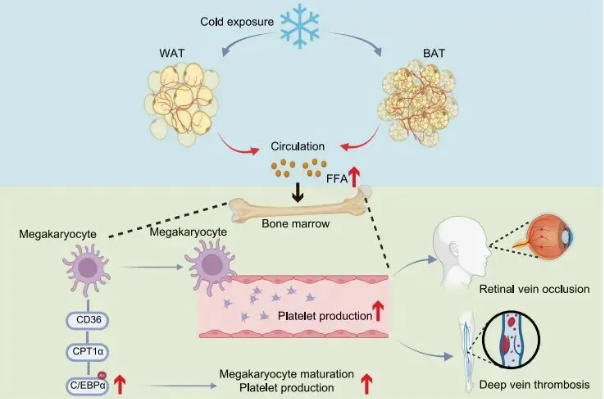
Image captured from the literature.
To validate the relevance of these findings in humans, the research team recruited healthy volunteers and conducted a prospective, small-scale study. Following cold exposure, participants exhibited a significant increase in peripheral blood FFA levels, accompanied by an elevation in platelet counts. The team further performed a retrospective analysis of clinical data from several years at the First Hospital of Longyan City, Fujian Province, focusing on patients with deep vein thrombosis and retinal vein occlusion. They found that, during winter, patients generally had higher platelet levels compared with those admitted in summer, suggesting that human platelet counts also rise in response to cold exposure.
In summary, this study has advanced our understanding of the biological effects of cold and introduced key concepts. In healthy individuals, cold‑induced nonshivering thermogenesis may confer health benefits; however, its effects should be carefully evaluated in patients at risk of venous thrombosis. Furthermore, the research has deepened our knowledge of megakaryocyte metabolic pathways and provides new scientific evidence to explain the century‑long observation of a higher incidence of cardiovascular diseases during winter.
Article link: https://www.nature.com/articles/s41422-026-01280-2
III. Referenced Products
In this study, three reagents from Li Ji Bio® were used for genotyping and Western blot analysis, serving as essential tools in molecular biology experiments.
1. One-Stop Mouse Tail DNA Rapid Identification Kit (AN11L218)
Function: Used for mouse genotyping.
Specific application: When generating megakaryocyte-specific Cpt1a knockout mice (Pf4-Cre; Cpt1a^flox/flox), researchers used this lysis reagent to directly lyse mouse tissue samples, release DNA, and then perform PCR amplification to determine whether the mice successfully carry the Pf4-Cre and Cpt1a^flox alleles. This constitutes the first step in validating the transgenic mouse model.
Note: EZ PCR Direct Mouse Tail Lysis Buffer (AN11L228) has been upgraded to a one‑step solution.
2. Three-color pre-stained protein marker (10–180 kDa) (AP13L052)
Function: Used as a molecular weight marker in Western blot analysis.
Specific application: During Western blotting, this marker is loaded alongside the protein samples from each group onto an SDS‑PAGE gel. It contains standard protein bands of known molecular weights, enabling researchers to estimate the approximate molecular weight of the target protein on the subsequent membrane and to verify that protein separation and transfer were performed correctly.
3. Hepes-Tris Protein Pre-Cast Gel (Precise Concentration, Glass Plates) (AP15L945)
Function: Used for protein electrophoretic separation in Western blotting.
Specific application: Researchers loaded equal amounts of each protein sample and molecular weight markers onto a 10% SDS‑PAGE gel for electrophoresis, thereby separating the proteins according to their molecular weights. The separated proteins were then transferred to a PVDF membrane, followed by antibody incubation and signal detection, enabling analysis of expression changes in target proteins (e.g., acetylation levels of C/EBPα, β‑oxidation‑related proteins, etc.).
Group Website
-
Contact Information
Landline phone:021-50778506
Business Manager:18616108315Business Cooperation/Scholarships:18616108697
Address:4th Floor, Building 27, Lane 908, Ziping Road, International Medical Park, Pudong New Area, Shanghai
Email:ztt0005@obiosh.com

WeChat Official Account
Online Customer Service 1
Online Customer Service 2
 Telephone consultation


