


 返回
返回
返回

IF=18.1 | The team led by Li Qingfeng at Jiaotong University has discovered that JAK1 can recapitulate a protective effect, offering new therapeutic strategies for skin fibrosis, plastic surgery–related skin expansion, and other conditions.
I. Literature Review
On September 11, 2026, the team led by Li Qingfeng at the Ninth People’s Hospital, affiliated with Shanghai Jiao Tong University School of Medicine, jointly published an academic paper titled “LGR5-positive fibroblasts orchestrate skin mechanoadaptation through JAK1 modulation” in Nature Communications (latest impact factor: 18.1).
The study found that mechanical stress can induce the dermis to produce LGR5. ⁺ Regulatory fibroblasts (LGR5 ⁺ MIRFs). Mechanical signals via YAP ‑ AP ‑ 1 Induces LGR5 expression; LGR5 inhibits JAK by directly binding to JAK1. ‑ The STAT pathway restrains fibrosis and excessive inflammation, mediating cutaneous mechanical adaptation; Lgr5 knockout leads to severe fibroinflammatory responses upon mechanical stimulation, whereas local JAK1 inhibition can recapitulate this protective effect, offering new therapeutic strategies for skin fibrosis and plastic surgery–related skin expansion.
Citing Li Ji Bio® products:
1. AC04L011-EZ Trans Plus Cell Transfection Reagent (II)
(Image captured from the literature)
II. Literature Overview
Mechanical adaptation is an extremely important yet poorly understood mechanism in the biology of mesenchymal tissues. In this study, we identified a class of regulatory fibroblasts—LGR5+ MIRFs—in the dermis of both mice and humans, which are induced by mechanical stimuli. Their formation depends on YAP/AP‑1–mediated transcriptional regulation. LGR5+ MIRFs promote adaptive tissue remodeling by coordinating extracellular matrix reorganization while suppressing inflammatory responses. When these MIRFs are ablated or the Lgr5 gene is specifically deleted in fibroblasts, what would normally be an adaptive response to tissue stretching instead gives rise to pathological fibrotic reactions; conversely, overexpression of Lgr5 in the dermis enhances tissue extensibility. Mechanistically, we uncovered an atypical interaction between LGR5 and JAK1 that inhibits the JAK‑STAT signaling pathway, thereby directly linking mechanosensation to kinase‑dependent signaling. Local application of a JAK1 inhibitor can recapitulate the tissue‑remodeling‑promoting effects of LGR5+ MIRFs, offering a viable therapeutic strategy for optimizing skin extensibility, treating stretch marks, and alleviating fibrotic diseases. Our work redefines the function of LGR5 as a ubiquitous mechanosensitive factor in mesenchymal tissues across diverse organisms, while also providing a new theoretical framework for understanding how tissues adapt to mechanical stress.
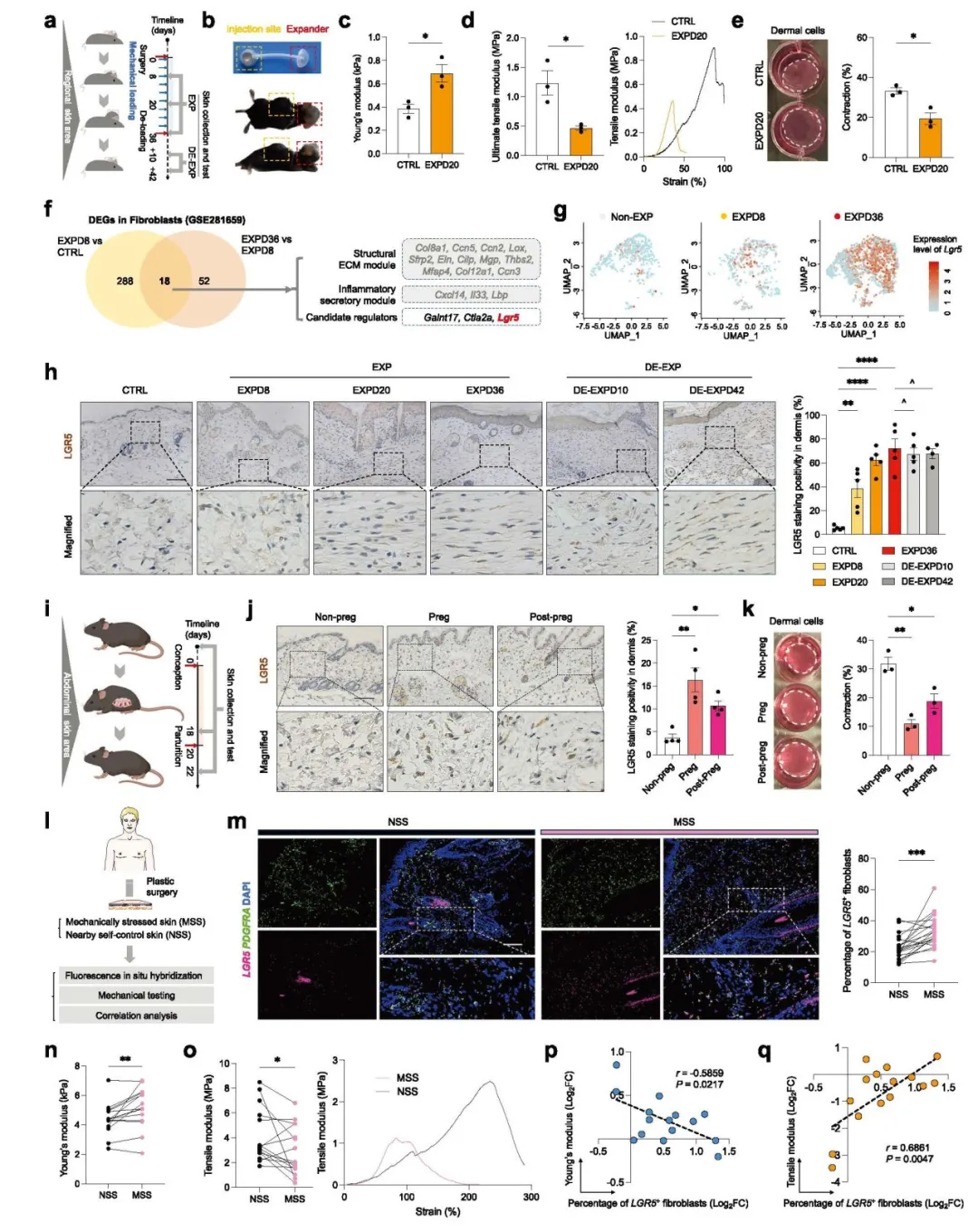
Image captured from the literature.
The research team identified a population of mechanically induced LGR5‑positive modulatory fibroblasts (LGR5+ MIRFs) in both mouse and human dermis, whose induction relies on a YAP/AP‑1‑dependent transcriptional program. LGR5+ MIRFs channel mechanical cues into adaptive tissue remodeling by coordinating extracellular matrix reorganization and suppressing inflammation. Depletion of LGR5+ MIRFs or fibroblast‑specific Lgr5 knockout converts adaptive stretching into pathological fibrotic inflammation, whereas dermal overexpression of Lgr5 enhances tissue extensibility.
Mechanistically, the study found that a noncanonical LGR5–JAK1 interaction suppresses JAK–STAT signaling, directly coupling mechanosensation to kinase pathway activity. Local inhibition of JAK1 recapitulates the remodeling‑promoting effects of LGR5+ MIRFs, suggesting a translational therapeutic strategy for optimizing skin expansion, treating stretch marks, and mitigating fibrotic diseases.
This study redefines LGR5 as a conserved stromal mechanosensor and provides a new conceptual framework for understanding adaptive tissue plasticity in response to mechanical stress.
Article link: https://www.nature.com/articles/s41467-026-77113-y
III. Referenced Products
In this study, Li Ji Bio®’s EZ Trans Plus Cell Transfection Reagent (II) was used to transfect human foreskin fibroblasts (HFF), a primary human skin fibroblast cell line, with an exogenous overexpression plasmid. Cells were harvested 48 hours post-transfection for subsequent molecular and functional analyses.
1. AC04L011-EZ Trans Plus Cell Transfection Reagent (II)
Specific applications:
1. Mechanism section: LGR5 ‑ JAK1 interaction validation: Co-transfection of plasmids encoding different truncated LGR5 mutants with JAK1 demonstrated that LGR5 binds to JAK1 via its N‑terminal domain, rather than through a classical JAK‑inhibitory mechanism. ‑ The STAT pathway—this constitutes the core molecular mechanistic evidence for the entire paper.
2. Upstream pathway YAP/AP ‑ 1 Regulation of LGR5: Overexpression of LGR5 in HFF cells sustains YAP activation, confirming that YAP collaborates with AP. ‑ 1. Enhance LGR5 transcription.
3. Cell phenotype validation: LGR5‑overexpressing HFFs were generated, and experiments on matrix contraction and cytokine secretion were performed to demonstrate that LGR5 inhibits the pro‑fibrotic and pro‑inflammatory phenotypes of fibroblasts.
Group Website
-
Contact Information
Landline phone:021-50778506
Business Manager:18616108315Business Cooperation/Scholarships:18616108697
Address:4th Floor, Building 27, Lane 908, Ziping Road, International Medical Park, Pudong New Area, Shanghai
Email:ztt0005@obiosh.com

WeChat Official Account
Online Customer Service 1
Online Customer Service 2
 Telephone consultation


