


 返回
返回
返回

IF=37 | High-impact publication in Cell Metabolism: A collaborative study by the Shanghai Institute of Materia Medica and East China University of Science and Technology reveals a novel microbial metabolic modification that drives the pathogenesis of fatty liver disease.
I. Literature Review
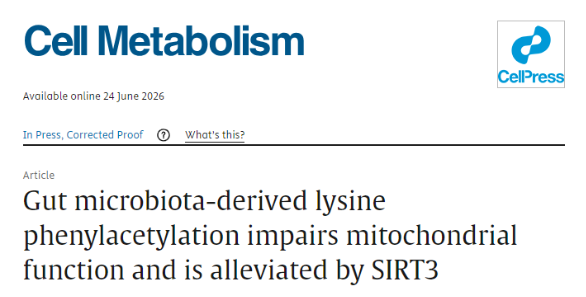
On June 24, 2026, a team led by Researchers Minjia Tan, Jingya Li, and Junyu Xu from the Shanghai Institute of Materia Medica, Chinese Academy of Sciences, together with Professor Bangce Ye’s group from East China University of Science and Technology, jointly published an academic paper titled “Gut microbiota-derived lysine phenylacetylation impairs mitochondrial function and is alleviated by SIRT3” in Cell Metabolism (latest impact factor: 37).
Teamwork has uncovered a novel mechanism by which phenylacetylation modifications in the gut microbiota induce mitochondrial dysfunction and promote hepatic steatosis.
(Image captured from the literature)
Du Wei, a postdoctoral researcher at East China University of Science and Technology, along with Researcher Xu Junyu and Associate Researcher Li Yufeng from the Shanghai Institute of Materia Medica, Zhang Mingya, a joint doctoral student co-supervised by the Shanghai Institute of Materia Medica and Fudan University, Huang Yidan, a doctoral student at the Shanghai Institute of Materia Medica, and Zhao Shaoqian, an attending physician in the Department of Endocrinology at Ruijin Hospital of Shanghai Jiao Tong University, are the co-first authors of the paper.
Researcher Minjia Tan, Researcher Jingya Li, Researcher Junyu Xu of the Shanghai Institute of Materia Medica, and Professor Bangce Ye of East China University of Science and Technology are the co-corresponding authors of this paper.
This work was supported by funding from the National Natural Science Foundation of China, the Ministry of Science and Technology’s Key R&D Program, the Shanghai Municipal Science and Technology Innovation Action Plan, and the Chinese Academy of Sciences’ Strategic Priority Science and Technology Program, among others.
II. Literature Overview
Cited from Li Ji Bio ® Product:
AP36L036—Bovine Serum Albumin, Free of Fatty Acids
Gut microbiota dysbiosis is one of the key factors in the onset and progression of metabolic diseases; however, the scientific community currently lacks a systematic understanding of the underlying molecular mechanisms governing “gut microbiota–host” interactions. Existing studies have consistently demonstrated that microbial metabolites serve as critical mediators of this bidirectional crosstalk, functioning either as signaling molecules or metabolic substrates to modulate intracellular signaling pathways, reshape the host’s metabolic network, and regulate epigenetic and transcriptional processes, thereby altering host cellular physiology. Although previous literature has shown that short-chain fatty acids such as propionate and butyrate can influence physiological and pathological processes by modulating host protein post‑translational modifications (PTMs), it remains unclear whether microbial metabolites can drive disease pathogenesis by regulating novel, as yet unidentified host PTMs. Moreover, the intricate regulatory networks formed by diverse microbial metabolites and host PTMs still require systematic exploration and elucidation.
This study integrates multidisciplinary approaches, including high-resolution mass spectrometry, chemical biology, molecular and cellular biology, and clinical sample analysis, to identify and report for the first time in vivo a novel protein post-translational modification—lysine phenylacetylation (Kpaa). Tracing experiments demonstrate that Kpaa formation depends on dietary phenylalanine and its gut microbiota‑derived metabolite, phenylacetic acid (PAA). In an obese mouse model induced by a high‑fat diet, intestinal commensal bacteria significantly increase PAA levels in feces, peripheral serum, and liver tissue. Functional enzymology further reveals that the host acyl‑CoA synthetase ACSF2 catalyzes the conversion of phenylacetic acid into phenylacetyl‑CoA, which serves as an acyl donor to promote intracellular lysine phenylacetylation; moreover, this modification exhibits dynamic, reversible regulation and can be specifically removed by the deacylase SIRT3. Proteomic analyses indicate that target proteins undergoing Kpaa are highly enriched in mitochondria. Mechanistic studies show that lysine 481 of the mitochondrial chaperone HSP60 is subject to phenylacetylation, thereby modulating the mitochondrial unfolded protein response and disrupting mitochondrial homeostasis, thus promoting the onset and progression of metabolic dysfunction‑associated steatotic liver disease (MASLD). Further analysis of clinical samples demonstrates that, in obese patients, the pathological progression of hepatic MASLD correlates significantly with the level of Kpaa modification in liver proteins, while it is inversely correlated with hepatic SIRT3 expression. These findings suggest that lysine phenylacetylation of mitochondrial proteins may represent a key molecular event underlying the downregulation of hepatic SIRT3, which exacerbates immune infiltration and fibrosis progression.
In summary, this study integrates three key components—dietary nutrition, gut microbiota metabolites, and novel protein post-translational modifications—and links them to host mitochondrial homeostasis regulation. It unveils a new “gut microbiota–host” interaction mechanism underlying the “diet–gut microbiota–host protein modification–disease phenotype” axis. The findings demonstrate that lysine phenylacetylation, mediated by gut microbial metabolites, is a critical driver of disease progression in MASLD and metabolism‑associated steatohepatitis (MASH), thereby providing new theoretical insights and potential therapeutic targets for elucidating the pathogenic mechanisms of metabolic‑related fatty liver disease and for developing targeted interventions.
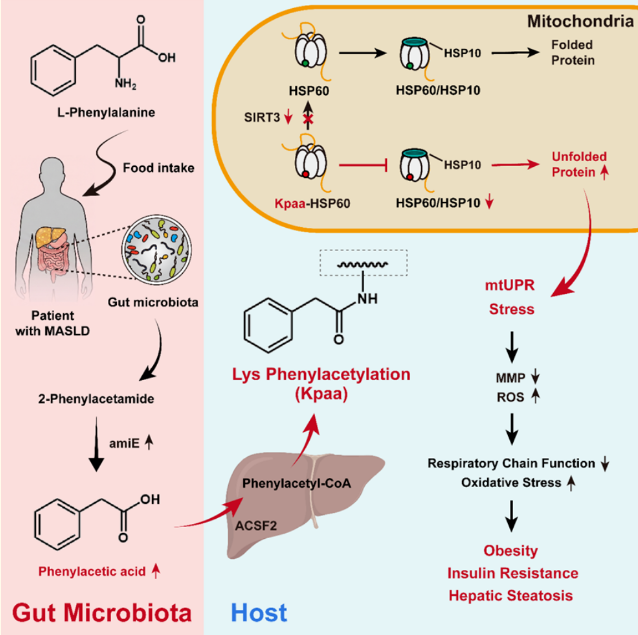
Image captured from the literature.
Article link: https://www.sciencedirect.com/science/article/pii/S1550413126002263
Group Website
-
Contact Information
Landline phone:021-50778506
Business Manager:18616108315Business Cooperation/Scholarships:18616108697
Address:4th Floor, Building 27, Lane 908, Ziping Road, International Medical Park, Pudong New Area, Shanghai
Email:ztt0005@obiosh.com

WeChat Official Account
Online Customer Service 1
Online Customer Service 2
 Telephone consultation


