


 返回
返回
返回


EZ Trans Pro Cell Transfection Reagent (GMP)

One click copying of product information
-
AC04L0325mL2400
-
AC04L03350mL8800
-
AC04L034500 mL48000
- Product Description
- Product FAQ
- COA
- Product Literature
- MSDS
- Operation video
-
Product Description
EZ Trans Pro Cell Transfection Reagent (GMP), a next-generation transfection reagent, operates on the principle that a positively charged cationic polymer forms a positively charged complex with the negatively charged phosphate groups of nucleic acids. This complex then interacts with the negatively charged proteoglycans on the cell surface and is internalized into the cell via endocytosis.
This product has been optimized by Li Ji Bio and features high transfection efficiency, low cytotoxicity, simple operation, excellent reproducibility, and broad applicability.
Product ingredients
Product Name
Specifications
EZ Trans Pro Cell Transfection Reagent (GMP)
5 mL
EZ Trans Pro Cell Transfection Reagent (GMP)
50 mL
EZ Trans Pro Cell Transfection Reagent (GMP)
500 mL
Transportation and Save
Blue ice transport. Store at 4°C; shelf life: 12 months. 【 Note 】: Do not freeze!
Instructions for Use
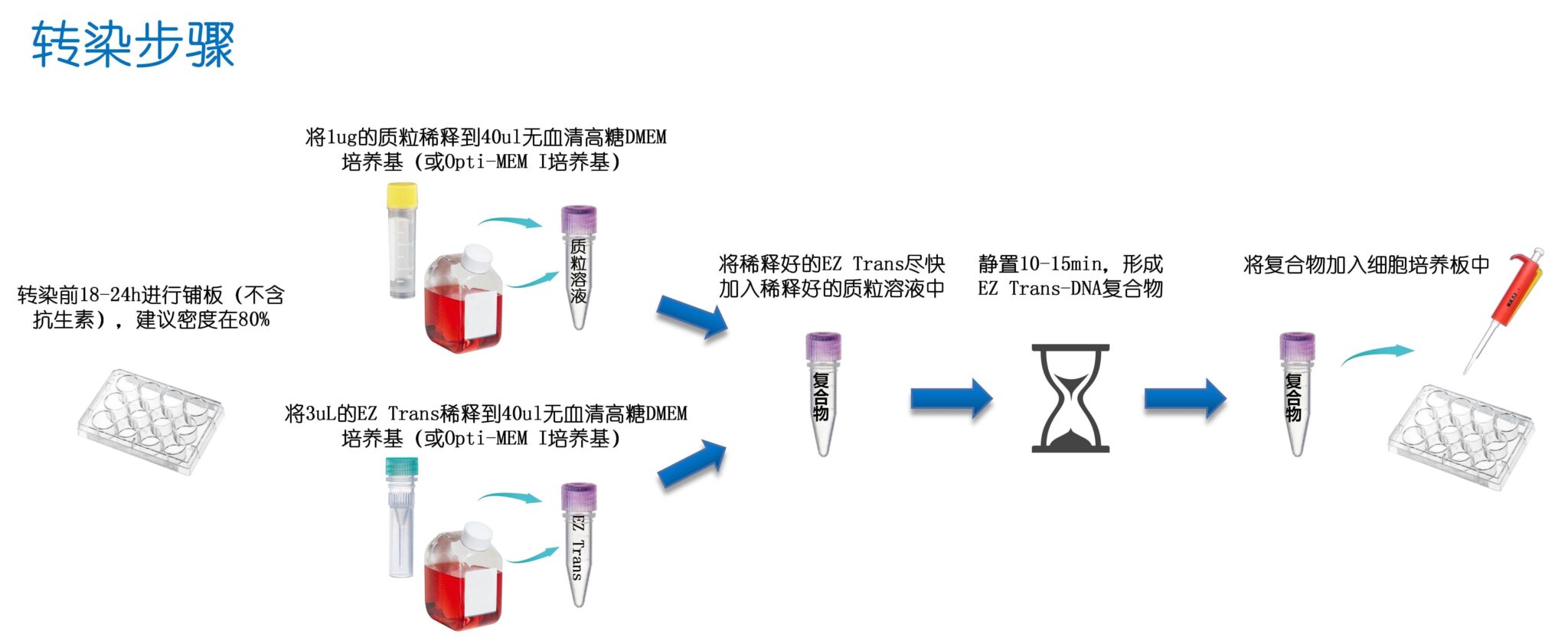
This product is intended solely for scientific research and must not be used for clinical diagnosis, treatment, or any other purposes.
-
Q: The cells we transfected contain antibiotics. Will the antibiotics definitely affect transfection efficiency?
A: If possible, avoid adding antibiotics altogether. In theory, antibiotics should not penetrate cells; however, transfection reagents can increase cell permeability, allowing antibiotics to enter and potentially compromising experimental results.
-
Q: The protocol specifies using Opti‑MEM to dilute both the plasmid and the transfection reagent. Can 1640 be used instead? Also, why must the plasmid and the transfection reagent be diluted separately before mixing? Couldn’t the transfection reagent simply be added directly to the plasmid solution, mixed, and then diluted with culture medium?
A: EZ Trans cell transfection reagent is a cationic transfection agent that requires specific conditions to form a complex with DNA. At an optimal concentration, it facilitates the efficient incorporation of DNA‑bound complexes into cells. If the two are mixed directly, they can rapidly aggregate into polymers with heterogeneous morphologies, potentially exposing the DNA on the surface and hindering its uptake, thereby reducing transfection efficiency. Therefore, the order in which EZ Trans and DNA are combined is critical. Most cultured cells are maintained in fetal bovine serum, whose composition is highly complex and not fully characterized. While the components of cell transfection reagents are well defined, it remains uncertain whether they might interact with unknown constituents in fetal bovine serum. In fact, such interactions often compromise transfection performance across many reagents. Consequently, during the formation of the EZ Trans–DNA complex, it is essential to minimize exposure to serum.
-
Q: The protocol states, “Assess transfection efficiency within 24–48 hours.” Does this refer to the 24–48 hours after replacing the complex-containing culture medium with serum‑supplemented medium, or to the 24–48 hours following addition of the transfection complex?
A: All times are counted from the moment the EZ Trans-DNA complex comes into contact with the cells.
-
Q: Low transfection efficiency: Interfering or inhibitory factors are present during the preparation of the DNA–transfection reagent complex.
A: Since serum and antibiotics can interfere with the formation of the DNA–transfection reagent complex, please use antibiotic‑free, serum‑free medium or Opti‑MEM during preparation.
-
Q: Low transfection efficiency and high cytotoxicity—cell density has not been optimized.
A: During DNA transfection and DNA–siRNA co-transfection, maintain cell confluency at 60%–70%; during siRNA transfection, keep cell confluency around 50%.
-
Q: How do you determine the transfection efficiency in an experiment?
A: It is recommended to include a positive control, such as green fluorescent protein (GFP), for each transfection.
-
Q: Low transfection efficiency—leaving the transfection complex at room temperature for an extended period.
A: EZ Trans cell transfection reagent should be stored at 4°C. The optimal incubation conditions for the transfection complex are room temperature for 10–20 minutes; prolonged incubation can significantly reduce transfection efficiency, so please ensure the incubation time does not exceed 20 minutes.
-
Q: Low transfection efficiency—centrifuge the transfection complex at high speed.
A: When forming the transfection complex, standard protocols recommend vortexing the transfection reagent and DNA or siRNA for a few seconds to generate a highly efficient complex. If you wish to pellet any complexes adhering to the tube walls, be sure to centrifuge at a very low speed—e.g., 80g for 5 seconds.
-
Q: High cytotoxicity — DNA amount is too high
A: It is recommended to plot a dose–response curve to determine the optimal DNA concentration.
-
Q: High cytotoxicity—excessive transfection reagent dosage
A: It is recommended to plot a dose–response curve to determine the optimal amount of transfection reagent.
-
Q: High cytotoxicity—cell condition is poor during transfection.
A: The transfection efficiency of EZ Trans cell transfection reagent is not affected by serum in the culture medium; therefore, we recommend using a complete culture medium containing 10% fetal bovine serum and antibiotics during transfection to optimize cell viability.
-
Q: High cytotoxicity—antibiotics are added too early during stable transfection.
A: Please add the selection antibiotic 48 hours after transfection.
-
Fill in the product batch number for inquiry
-
Fill in the product batch number for inquiry
Best Sellers

Popular Articles
Group Website
-
Contact Information
Landline phone:021-50778506
Business Manager:18616108315Business Cooperation/Scholarships:18616108697
Address:4th Floor, Building 27, Lane 908, Ziping Road, International Medical Park, Pudong New Area, Shanghai
Email:ztt0005@obiosh.com

WeChat Official Account
Online Customer Service 1
Online Customer Service 2
 Telephone consultation


